Report Reveals Schools’ ‘Roasting’ Ordeal
A recent report by the environmental organization Greenpeace has brought the issue of extreme heat in Spanish schools to the forefront of public attention. Using professional thermal imaging cameras, the organization conducted on-site inspections at six schools in Alicante, Ourense, Barcelona, Madrid, and Seville.
The findings are alarming. According to current Spanish regulations, the indoor temperature for sedentary work, such as classroom learning, should not exceed 27°C. However, none of the inspected schools met this standard, with most classroom temperatures far exceeding the limit. Some cafeterias even reached 30°C. Outdoors, playground surfaces under direct sunlight soared to as high as 50°C. Experts point out that students’ concentration and learning efficiency significantly decrease when the ambient temperature surpasses 24°C.
Government Accused of Inaction as Parents Take Matters Into Their Own Hands
Faced with the worsening problem of overheated schools, the response from local governments has been widely criticized as inadequate. For example, the regional government of Madrid was reportedly dismissive, responding with comments like “heat is just heat” and failing to offer effective solutions.
Against this backdrop, parents in some regions have been forced to take matters into their own hands. In regions like Murcia, parent-teacher associations have organized fundraisers, such as bake sales and raffles, to raise money to install air conditioning systems in schools and improve their children’s learning environment.
Elche Parents’ Symbolic Protest
In the city of Elche, within the Valencian Community, parents’ protests have escalated. The parent-teacher associations of 10 public schools have jointly submitted a formal petition to Mayor Pablo Ruz and all city council members.
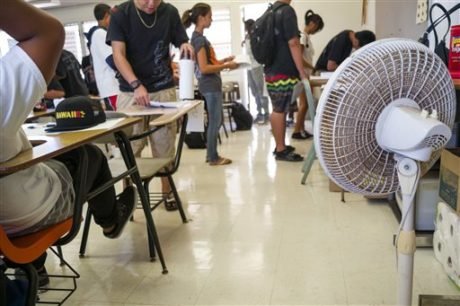
The petition’s core demand is highly symbolic: it calls for the city council to turn off the air conditioning in its own chambers during all plenary sessions held in June, July, and September. Through this act of protest, parents hope to make policymakers “share the same hardship” and experience firsthand the sweltering conditions students endure in their classrooms, thereby compelling them to address the urgent lack of cooling facilities in schools.
Protest Sparks Public Solidarity and Debate
The Elche parents’ actions quickly resonated with the Spanish public, drawing widespread support and praise. Many people took to social media to express their approval, believing the protest gets to the heart of the matter. Some commentators even suggested that government buildings should also go without air conditioning until all schools are properly equipped.
This incident has not only exposed the shortcomings in educational infrastructure in parts of Spain but has also sparked a deeper public conversation about educational equity, student welfare, and government responsibility. There is a growing consensus that the government must prioritize ensuring a basic and safe learning environment for students, rather than leaving parents and children to bear the consequences of climate change alone.
