A New Milestone in European Pediatric Minimally Invasive Surgery
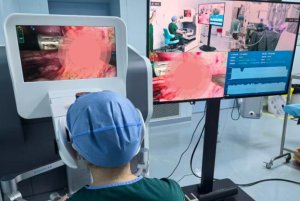
Recently, the Hospital Universitario Vall d’Hebron in Barcelona, Spain, announced the successful completion of Europe’s first single-port robot-assisted surgery on a pediatric patient. The patient was a 12-year-old boy suffering from multiple kidney stones (some over 3 cm in diameter) that caused a severe infection, leading to the complete loss of function in one kidney. The medical team performed a nephroureterectomy using the single-port robotic system through a single, tiny incision.
The hospital stated that compared to traditional multi-port robotic surgery, which requires several incisions, the single-port technique significantly reduces surgical trauma. For pediatric patients, this means less postoperative pain, a shorter recovery period, and a lower risk of complications, representing a major step forward in pediatric minimally invasive surgery.
Core Technology from China
The equipment used in this historic operation was the SHURUI Single Port surgical robot, developed by the Chinese company Surgerii Robotics. The system’s key advantage is its ability to insert a high-definition camera and multiple surgical instruments simultaneously through a single incision, allowing them to expand and perform complex, precise maneuvers within a confined space.
The robotic system has received EU CE certification for use in both adult and pediatric surgery. Albert Salazar, the director of Vall d’Hebron University Hospital, noted that it is currently the only single-port surgical robot system in the EU explicitly approved for pediatric surgery, with its safety and efficacy being officially recognized.
The Hospital’s Strong Foundation in Robotic Surgery
This success is no coincidence. Vall d’Hebron University Hospital has over 16 years of extensive experience in robot-assisted surgery. As early as 2008, the hospital performed Europe’s first pediatric multi-port robotic surgery. To date, it has completed over 200 pediatric urological robotic surgeries, establishing a mature technical framework and clinical team.
Currently, the hospital has four robotic operating rooms: three equipped with multi-port robots and one with this new single-port system from China. The introduction of this new equipment is expected to increase the hospital’s annual volume of robotic surgeries by 200 to 300 cases, covering various departments including pediatric surgery, urology, and general surgery.
Looking to the Future with Cutting-Edge Technology
The adoption of this new technology is part of the hospital’s ‘New Digital Technologies for Personalized Diagnosis and Treatment of Congenital and Complex Diseases’ project, supported by the EU’s STEP fund. Looking ahead, the hospital is actively exploring the integration of robotic surgery with ‘digital twin’ technology. By creating precise virtual models of a patient’s organs or the surgical procedure, doctors can plan and conduct simulations before the operation and receive real-time navigation and assistance during surgery, further enhancing surgical precision and safety.
