A New Policy in Response to Heat Advisories
As the first summer heatwave sweeps across Spain, the Spanish State Meteorological Agency (AEMET) has issued persistent high-temperature warnings for several regions, with temperatures expected to exceed 35°C and even approach the 40°C mark. In this context, one bar has taken a noteworthy preventive measure to ensure the health and safety of its employees in the scorching heat.
The establishment posted a sign at its entrance, clearly informing customers: “Please be advised that during rain or extreme heat (over 35 degrees), we will not offer table service on the terrace.” This means that while the bar remains open during severe weather, customers choosing to sit on the outdoor terrace will need to come inside to place and pick up their orders.
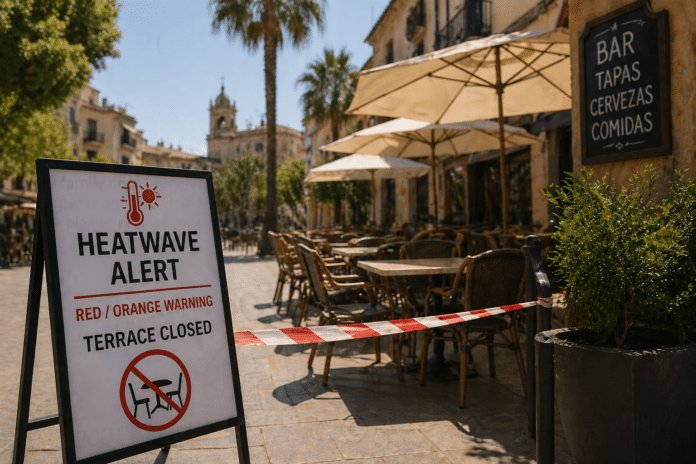
Social Media Buzz and Public Support
After a photo of the sign was shared on social media, it quickly went viral, sparking widespread discussion. The vast majority of users praised and supported the bar’s decision, viewing it as a demonstration of corporate social responsibility. Many comments pointed out that under the blazing sun, the perceived temperature on an outdoor terrace is far higher than the official weather data, and requiring waitstaff to move back and forth in such harsh conditions could easily lead to serious health issues like heatstroke.
One top-rated comment read: “If you want to sunbathe in a 40-degree square, that’s your choice, but please go inside and get your own drink. Waitstaff shouldn’t have to serve you under inhuman conditions; they have a right to dignified work too.” This sentiment represents the mainstream public opinion: customer convenience should not override a worker’s fundamental right to health.
Worker Protection in Extreme Weather Becomes a Focal Point
This is not an isolated incident; it reflects a growing concern in Spanish society regarding the protection of outdoor workers during extreme weather. In recent years, as global warming has led to more frequent and extreme summer heat, the safety of outdoor work in sectors like construction, agriculture, and food service has become a key focus for labor inspectorates.
A growing number of forward-thinking businesses are proactively taking measures, such as adjusting work hours to avoid the hottest part of the afternoon, increasing break frequency, providing cooling supplies, or, as in this case, directly reducing non-essential outdoor labor. Although a very small minority has expressed concern that such measures might affect Spain’s traditional terrace culture and experience, in this debate between humanitarian concerns and business operations, the call to protect workers’ lives and health has clearly prevailed, earning widespread understanding and support from consumers.
