Summary
Spain has recently passed its most significant traffic reform bill in nearly two decades, which will officially take effect on October 1, with some provisions having a transitional period. The new legislation aims to enhance road safety by introducing new mandatory requirements for drivers and passengers of various types of vehicles.
1. General Rules for Highways and Urban Traffic
Responding to Extreme Weather and Congestion: On highways or expressways where traffic is difficult due to snowfall, all vehicles must drive in the rightmost lane and are prohibited from overtaking. The left lane must be kept clear for rescue and snow removal vehicles. In severe traffic jams, vehicles on both sides of the road must move towards the outer edges to form an ‘emergency corridor (carril de emergencia)’ in the middle for emergency vehicles to pass.
Ensuring Pedestrian and Student Safety: The new rules will eliminate traffic light patterns where a ‘flashing amber light for vehicles’ and a ‘green light for pedestrians’ are active simultaneously, to prevent conflicts between turning vehicles and pedestrians. Additionally, for the first time at the national level, ‘safe school routes (caminos escolares seguros)’ will be legally established, empowering local authorities to implement stricter traffic controls around schools, such as mandatory speed limits and traffic restrictions during peak hours.
Regulations for Parked Motorhomes: It is explicitly stated that when a motorhome is parked, it cannot use external equipment that extends beyond the vehicle’s outline (such as awnings or fixed supports) and is prohibited from discharging any wastewater.
2. New Requirements for Motorcycles and Mopeds
Mandatory Riding Gear: On all roads, motorcycle riders and passengers must wear closed-toe footwear and are forbidden from wearing flip-flops or sandals. On interurban roads (interurbanas), protective gloves are mandatory. Furthermore, starting from October 1, 2027, all helmets used must be officially certified (homologado) models.
Privileges in Congested Areas: In clearly marked congested sections, motorcycles are permitted to ride on the right shoulder (arcén derecho), provided their speed does not exceed 30 km/h.
3. Rules for Bicycles and the Food Delivery Sector
Helmet and Reflective Vest Requirements: All cyclists on interurban roads must wear a helmet. For professional food delivery riders, wearing a helmet and a reflective vest is mandatory at all times on all types of roads, with violations subject to a €200 fine.
New Overtaking Rules for Motor Vehicles: When overtaking a bicycle on an interurban road, a motor vehicle must reduce its speed by at least 20 km/h below the road’s speed limit. On multi-lane roads, the overtaking vehicle must move completely into the adjacent lane and maintain a minimum lateral distance of 1.5 meters from the cyclist.
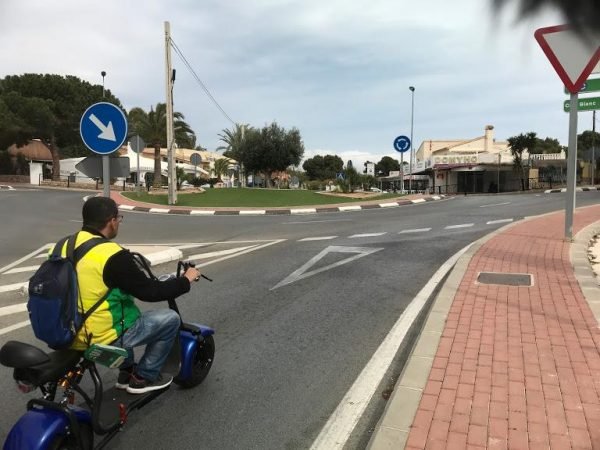
- Urban Cycling Regulations: To ensure safety, cyclists are encouraged to ride in the center of the lane in urban areas. Following motor vehicles must maintain a minimum safety distance of 5 meters from the cyclist ahead. On certain one-way streets with a 30 km/h speed limit, cyclists may be permitted to ride against traffic, subject to municipal approval and signage.
4. Regulations for E-Scooters and Other Personal Mobility Vehicles (VMPs)
Age and Speed Limits: The minimum age for riders of personal mobility vehicles, such as e-scooters and self-balancing scooters, is set at 15 years old. The maximum speed for these vehicles is restricted to a range of 6 to 25 km/h.
Mandatory Safety Gear: All riders must wear a helmet at all times. At night or in low-visibility conditions, they must also wear a reflective vest. Food delivery riders must also comply with this rule at all times, with violations carrying a €200 fine.
Operating Areas: As a general rule, e-scooters and similar vehicles are prohibited from being used on interurban roads, unless the road has a separate non-motorized vehicle lane or a cycle path.
