Barcelona Proposes New Policy to Target “Day-Tripper” Tourists
To address the growing problem of “overtourism,” the Barcelona City Council has recently proposed a radical tax adjustment plan. The plan aims to drastically increase the tourist tax for specific types of visitors from the current €11 per day to €30, a nearly threefold increase.
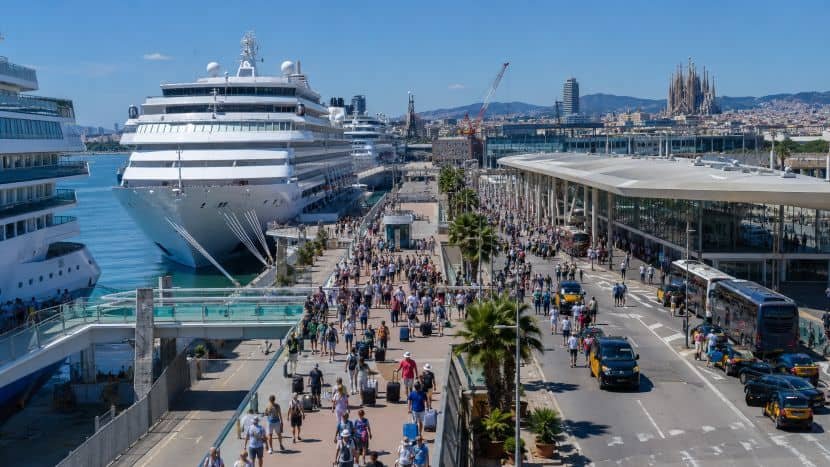
If the new regulation receives final approval from the Parliament of Catalonia, it will primarily affect cruise passengers who dock at the Port of Barcelona and stay for less than 12 hours. According to the proposal, these tourists, who currently pay an €11 tax (comprising a €5 municipal fee and a €6 regional fee), will face a flat €30 fee in the future.
Official Motive: Curb Low-Spending Tourism and Relieve Urban Pressure
Barcelona city officials have stated that the main goal of the measure is not to increase revenue but to act as a “deterrent” to curb “hit-and-run” tourism, which offers limited economic benefit to the city.
Official data shows that during the high season, these short-stay cruise passengers account for 7.5% of the total daily visitors to the city, yet their average stay is only 5.7 hours. They crowd popular attractions like the Sagrada Familia and La Rambla, exacerbating traffic congestion and environmental pressure. However, because they do not stay overnight and often dine on board, their spending has a minimal impact on the local economy. Marc Serra, a councilor from the left-wing party BComú promoting the bill, stated that the aim is to send a clear message: Barcelona does not welcome this type of tourism model.
Targeted Exemptions: Encouraging “High-Quality” Tourists
Notably, the tax proposal includes exemption clauses, reflecting its “precision-targeting” approach. If a cruise itinerary begins (embark) or ends (disembark) in Barcelona, passengers on board will be exempt from this high tax.
The government’s logic is that these tourists typically stay in Barcelona for at least one night before or after their cruise, thereby contributing real economic value through accommodation, dining, and transportation. They are considered “high-quality” tourists.
Industry Warning: A Potential Lose-Lose Situation Damaging Port Competitiveness
The proposal immediately sparked strong backlash from the tourism industry. Gloria Guevara, President & CEO of the World Travel & Tourism Council (WTTC), issued a stern warning, stating that “sudden, sharp tax increases rarely achieve their desired effect.”
The industry fears that the move will severely weaken Barcelona’s competitiveness against other Mediterranean ports, potentially leading cruise lines to reroute their ships to ports with lower taxes. Guevara pointed out that the cruise industry is a significant contributor to Barcelona’s economy, with the 4 million cruise passengers received annually contributing nearly €12 million in tax revenue in 2024 alone. A drastic tax hike could not only deter tourists but might also compel those who do disembark to cut back on all spending in protest, ultimately harming local businesses and employment.
