Nationwide High-Temperature Warnings and Health Risks
As the second summer heatwave of the year sweeps across Spain, temperatures continue to rise nationwide. The Spanish State Meteorological Agency (AEMET) has issued high-temperature warnings for 14 autonomous communities, with seven regions, including Andalusia and Madrid, reaching the “orange” alert level, where temperatures are expected to exceed 42°C. The Spanish Ministry of Health has placed most of the peninsula under a “red” high health risk status. According to data from the Carlos III Health Institute, the severe heat has had a significant public health impact, with 937 heat-related deaths recorded in June alone and another 153 in the first four days of July.
Extreme Fire Risk Across the Country
The sustained high temperatures and long-term drought have made vegetation exceptionally dry, dramatically increasing the risk of forest fires. According to data from AEMET and forest fire monitoring systems, nearly all of Spain’s autonomous communities, with few exceptions like Madrid, are at high or even extreme risk of forest fires. Catalonia, northern Valencia, Galicia, Murcia, and parts of Andalusia are classified as having the highest fire risk level. A total of 107 fire hotspots have been detected nationwide, with 41 high-temperature anomalies monitored in the province of Castellón (Valencian Community) alone. Currently, Catalonia has the highest number of active fires, making it a top priority for firefighting efforts.
Specific Incidents: Wildfires and Urban Precautions
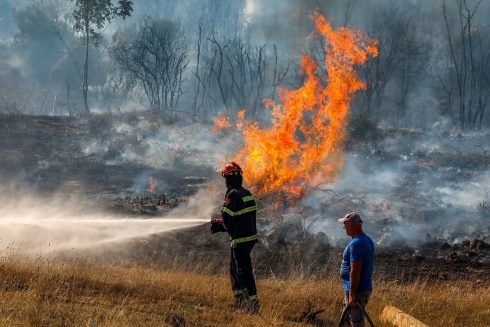
The severe fire risk has already materialized into disasters in some areas. In the municipality of Soneja, in the province of Castellón, Valencian Community, a forest fire has burned approximately 150 hectares and is approaching the Sierra de Espadán Natural Park. As a safety precaution, about 500 residents of the nearby town of Azuébar have been evacuated. Over 270 ground personnel and more than a dozen aircraft are battling the blaze, but with extreme temperatures of 44°C, there is still a risk of it getting out of control. Meanwhile, the Community of Madrid has also issued a yellow alert for thunderstorms and strong winds. To prepare for gusts that could exceed 70 km/h, the city council has announced the emergency closure of nine major city parks, including Retiro Park, to prevent dangers such as falling trees.
‘Dry Thunderstorms’ Exacerbate Future Threats
Meteorological authorities warn that “dry thunderstorms” may occur in some areas in the coming afternoons. Although these storms produce little rainfall, the lightning and strong gusts they generate can easily ignite new fires in dry forests and cause them to spread rapidly. Experts point out that the combination of high temperatures, drought, strong winds, and abundant dry vegetation creates a dangerous fire environment. Lightning and human negligence are the main causes of fires. Authorities have intensified monitoring and emergency deployment nationwide and are urging the public to strictly follow fire prevention regulations during this high-risk period. This includes prohibiting the use of open flames, discarding cigarette butts, or engaging in any activity that could create sparks in the wild to collectively prevent major wildfires.
