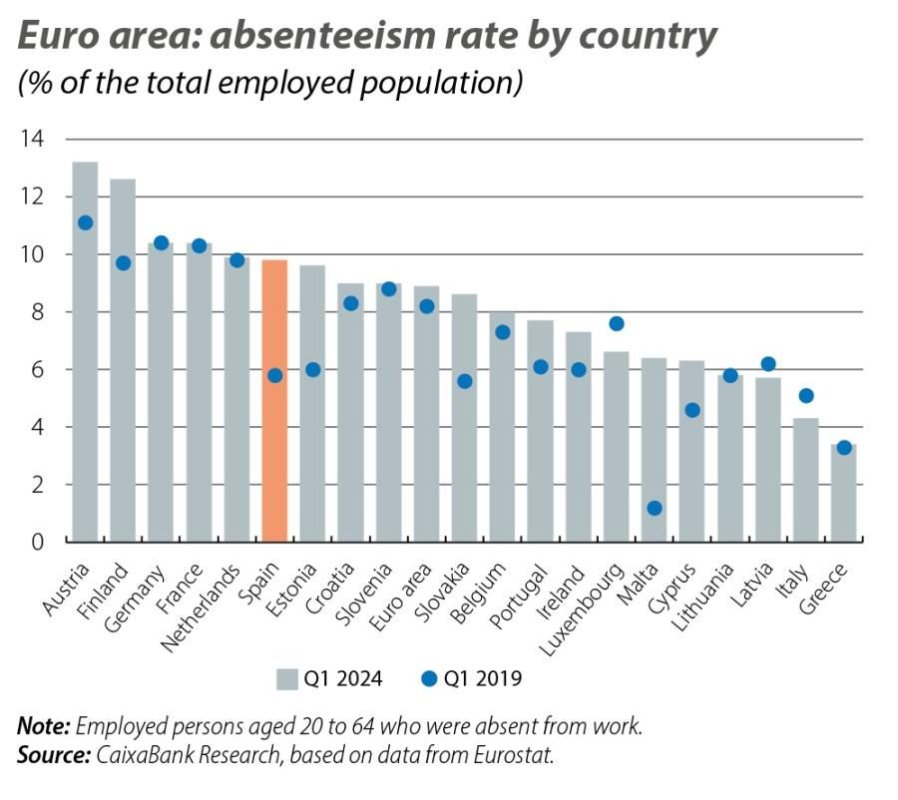
Spain’s labor market is facing an increasingly severe absenteeism problem. According to a report by the renowned institution Randstad Research, based on data from the first quarter of 2026, the country’s labor absenteeism rate has climbed to 7.2% of contracted hours, setting a new record and marking a 0.1 percentage point increase from the end of 2025.
1.6 Million Employees Absent Daily, with Sick Leave as the Main Factor
The report’s data shows that the 7.2% absenteeism rate is equivalent to over 1.6 million employees being absent from work on an average workday. This trend is no longer considered a short-term issue but has evolved into a structural challenge.
Among all absences, those due to illness or temporary disability (known in Spain as ‘Incapacidad Temporal’ or IT) accounted for 5.6% of contracted hours, making it the primary cause of absenteeism. Furthermore, the data reveals a worrying aspect: of the 1.6 million people absent daily, approximately 362,700 (22.6% of the total) were absent for reasons other than sick leave and without a justified explanation.
Significant Industry Differences: Industry and Services Are Hardest Hit
An analysis by sector shows clear disparities. The industrial sector has the highest absenteeism rate at 7.4%, with sick leave accounting for 5.7%. The services sector follows closely with a total rate of 7.2% (5.6% from sick leave). In contrast, the construction sector is in a slightly better position, with an overall rate of 6%, the lowest of the three main sectors.
Within more specific activities, some fields far exceed the average rate. Postal and courier services top the list with a 13.4% absenteeism rate, followed by gambling and betting activities (12%), and building maintenance and gardening services (11.8%). Conversely, sectors with relatively low absenteeism rates include employment-related services (3%), publishing (3.5%), and legal and accounting services (3.6%).
Regional Disparities Widen, with a Clear North-South Divide
There is also a significant gap in labor absenteeism across Spain’s regions. The situation is particularly severe in the north, with the Basque Country leading the nation at 9.4%, followed by Asturias (9.1%) and the Canary Islands (8.9%), all well above the national average. Notably, the rate in Asturias has risen by a full percentage point in one year, indicating a rapidly worsening trend.
On the other hand, the regions with the lowest absenteeism rates are mainly concentrated along the Mediterranean coast and in the capital. The Balearic Islands (5.9%), the Community of Madrid (6.2%), and La Rioja (6.4%) are the three regions with the lowest rates in the country. Additionally, absenteeism rates have risen in Andalusia and Aragon, reaching 7% and 7.6% respectively, while regions like the Canary Islands, La Rioja, and Cantabria have seen slight decreases.
