Overall Market Trend: Slower Transactions, Resilient Prices
Combining the latest 2026 data from Spain’s National Statistics Institute (INE) and valuation firm Gesvalt, the Spanish real estate market is undergoing a profound structural adjustment. Unlike the high-growth scenario of 2025 where both transactions and prices surged, 2026 is characterized by a new trend of “weakening sales and firm prices.”
Data shows that in the first quarter of 2026, home sales volume saw a slight year-on-year decline of 2.6%, indicating a cooling market. However, prices have not followed suit. As of April-May this year, the national average housing price has risen to €2,041 per square meter, a 12.4% increase compared to the same period last year and a 1.4% rise from the first quarter. For a 90-square-meter home, the average total price has increased from approximately €163,400 last year to the current €183,600, a value appreciation of over €20,000 in one year.
Demand and Supply: Mortgages Grow Against the Trend, Supply Gap Persists
The decline in market transaction volume is not due to weakened homebuying demand. On the contrary, mortgage lending data from the same period shows strong growth momentum. In the first quarter of 2026, a total of 131,500 new housing loans were issued in Spain, a significant year-on-year increase of 9.7%, providing strong evidence of sustained public interest in purchasing homes.
Analysts believe the primary issue in the current market is a long-term housing supply shortage. Resilient buyer demand coupled with limited housing stock has created a supply-demand imbalance, thereby supporting continued price increases. Although there are positive signs in new construction—with new housing permits rising by 9.3% year-on-year to 24,991 units and completions also up by 3.1%—the growth in permits far outpaces that of completions. This indicates a time lag between approval and market entry for new properties, making it difficult to alleviate the supply crunch in the short term.
Regional Price Divergence: Stark East-West Differences
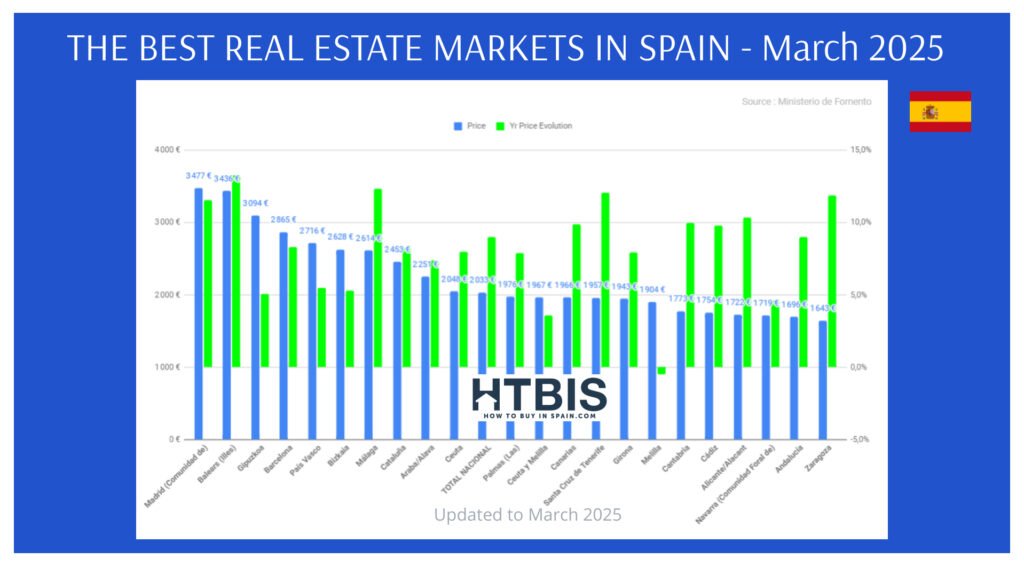
One of the most significant features of the Spanish property market in 2026 is the vast difference between regions. In terms of price growth, the Region of Murcia leads the nation with a staggering 18.2% year-on-year increase, making it the fastest-appreciating area. Cantabria and Valencia follow with growth rates of 14.7% and 13.7%, respectively.
In terms of absolute prices, the tiered price structure remains stable. The Balearic Islands top the national price chart with an average of €3,455 per square meter. The Community of Madrid and the Basque Country rank second and third, with prices of €3,333 and €2,774, respectively. Meanwhile, Spain’s western and south-central regions form the “affordable zones.” Among them, Extremadura has the lowest average housing price in the country at just €950 per square meter. Regions such as Castilla-La Mancha, Castilla y León, and Galicia also have average prices generally ranging from €950 to €1,300, offering more options for buyers on a budget.
