A Storm Stirred by Words
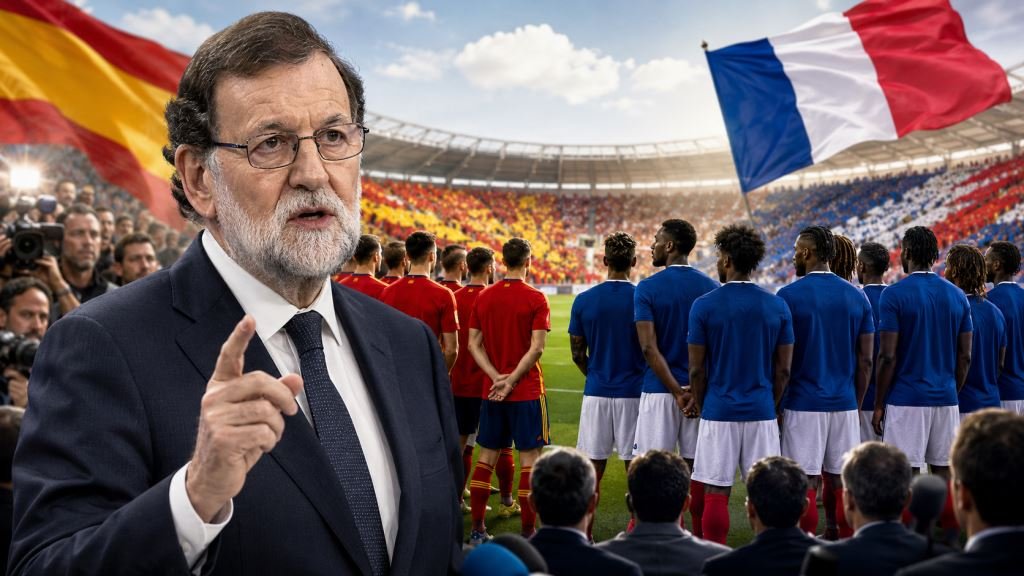
As the World Cup progresses, off-field controversies surrounding the French national team have intensified. Political figures from multiple countries have taken aim at the diverse backgrounds of the French players, with former Spanish Prime Minister Mariano Rajoy’s comments being the most inflammatory. In an article for a Spanish media outlet, he wrote of the French team: “It’s a high-level team. Of course, there isn’t a single Frenchman in it.”
This statement was not an isolated incident. Previously, Paraguayan senator Celeste Amarilla attacked French forward Kylian Mbappé with racially charged language, calling him “a Cameroonian from the colonies.” Argentinian deputy governor of Mendoza, Hebe Casado, also described the French team on social media as “an uneducated African team.” These comments quickly spread internationally, dragging sports into a quagmire of ‘heritage’ debates.
Swift Official Rebuttals and Condemnation
Various French sectors responded swiftly to the controversy. Philippe Diallo, President of the French Football Federation, stated clearly: “Our players don’t need to present any proof of nationality to the former Spanish prime minister. The French national team is the French national team.”
The French government’s stance was even stronger. Aurore Bergé, the minister in charge of combating discrimination, publicly called the remarks “unacceptable” and demanded apologies from Rajoy and Amarilla. Government spokesperson Maud Bregeon condemned Rajoy’s comments on RTL radio as “despicable,” arguing they exposed his “ignorance of France’s history and its very essence.” The French Embassy in Spain countered with data: of the 26 players on the team, 23 were born in mainland France, and the other three all hold French citizenship.
Even current Spanish Prime Minister Pedro Sánchez condemned the remarks, stating that his predecessor’s xenophobic comments “bring shame upon Spain,” creating a scene where the current administration had to perform damage control for the former one.
Who is French? A Two-Century-Old Debate
The notion that “there are no Frenchmen in the French team” fundamentally challenges the definition of “French.” This question has been debated in France for over two hundred years.
Since the French Revolution of 1789, the concept of national identity promoted by France has, in theory, transcended bloodline and origin. It emphasizes a citizen’s political and social belonging: any individual who accepts the laws of the Republic, lives within French society, and fulfills civic duties can become a member of the French community. This model, based on “jus soli” (right of the soil) and political identity, is distinct from nations that rely purely on “jus sanguinis” (right of blood).
However, a tension has always existed between theory and reality. While France promoted “Liberty, Equality, Fraternity,” it maintained a vast colonial empire and subjected colonial populations to discriminatory treatment. This historical contradiction laid the groundwork for today’s debates on identity.
Immigration and Colonial History: Shaping Modern France’s Diversity
The diverse backgrounds of the French team’s players are a direct reflection of France’s modern history. The National Museum of the History of Immigration in Paris even defines France as “one of Europe’s first countries of immigration.”
In the second half of the 19th century, to meet the labor demands of industrialization, France began to accept large numbers of immigrants from European countries like Belgium, Italy, Spain, and Poland. These early immigrants also faced exclusion and discrimination, but over time, their descendants have deeply integrated into French society.
A more profound impact came from France’s colonial history. Its empire once spanned Africa, Asia, and the Caribbean, with places like Algeria, Senegal, and Cameroon establishing long and complex demographic, linguistic, and economic ties with France. During the two World Wars, France recruited a large number of soldiers and laborers from its colonies, and their descendants form a significant part of contemporary French society. Therefore, the presence of players of African and North African descent on the French team is not a new phenomenon but a continuation of this long history. According to France’s National Institute of Statistics and Economic Studies (INSEE), as of 2024, there are approximately 7.6 million immigrants in France, making up 11.2% of the total population. Furthermore, the large number of descendants of immigrants born in France are, both legally and statistically, native-born French citizens.
Football: A Prism for a Diverse Society
Football frequently becomes a battleground for “heritage” theories because of its immense public exposure. On the world stage, a national team acts as a magnified social microcosm of its country, with its members’ skin color, names, and backgrounds subjected to global scrutiny.
In fact, similar attacks have been ongoing for decades. As early as the 1996 European Championship, French far-right politician Jean-Marie Le Pen questioned the “Frenchness” of the team. Even when France won its first World Cup in 1998, with the champion “Black-Blanc-Beur” (Black-White-Arab) team led by players like Zinedine Zidane hailed as a symbol of multicultural integration, the controversy never ceased. After France won again in 2018, figures like then-Venezuelan President Nicolás Maduro also made comments like “it was Africa that won the World Cup.”
These recurring arguments not only expose the historical ignorance of some commentators but also reflect a deeper, narrow view of identity based on race and skin color. Regardless of the outcome on the pitch, the debate over “who is French” is likely to continue.
