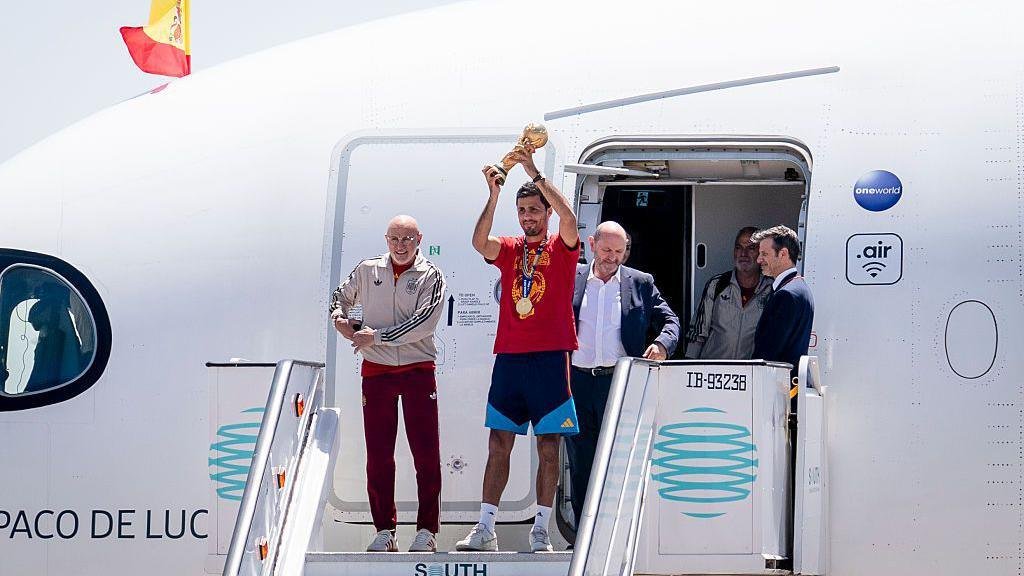
On July 19, 2026, the Spanish national team won the World Cup final, returning to the pinnacle of world football after 16 years and adding a second star to their iconic red jersey. The following day, the heroic team, laden with honors, arrived in Madrid to kick off a nationwide celebration.
A Hero’s Welcome: Received by the Head of State and Government
On July 20, the first stop for the entire Spanish national team upon arriving in Madrid was the Royal Palace. King Felipe VI and Queen Letizia, accompanied by Princess Leonor and Infanta Sofía, welcomed the team. The King congratulated and thanked the players as they held the World Cup trophy, shaking hands with each of them.
Following this, the team proceeded to the Moncloa Palace, the official residence of the Prime Minister. Spanish Prime Minister Pedro Sánchez awaited them outside and received the entire squad and coaching staff. The official reception demonstrated the nation’s highest respect for the champion team.
Madrid’s Euphoria: Hundreds of Thousands Line the Streets
After the official receptions, a massive public celebration unfolded in the streets of Madrid. An open-top double-decker bus carrying the entire team slowly made its way down the city’s main avenues, which were already packed with hundreds of thousands of people. Fans waved national flags and sang chants, turning Madrid into a sea of red and yellow. As the bus moved through the crowds, the players interacted with the enthusiastic public, sharing the joy of victory. It was a spectacular scene that Spanish fans had awaited for 16 years.
The Mastermind Coach: De la Fuente’s Slow-Burn Success
The man who led Spain to success is head coach Luis de la Fuente. His coaching career was not always smooth, and his path to glory has been described as a case of ‘slow and steady wins the race.’ His playing career was modest, and after retiring, he moved between lower-division clubs and even faced unemployment.
The turning point in his life came in 2013 when he became the coach of Spain’s U19 national team. From then on, he quietly toiled within the youth system of the Royal Spanish Football Federation (RFEF) for nearly a decade. He led the U19 and U21 teams to European championships and guided the Olympic team to a silver medal. During this time, he built deep-seated trust with many of the current national team’s key players, such as Rodri and Fabián Ruiz, during their youth team days.
At the end of 2022, De la Fuente officially took charge of the senior Spanish national team, initially facing widespread skepticism. However, he went on to lead the team to consecutive victories, winning the 2023 UEFA Nations League, the 2024 European Championship, and ultimately lifting the World Cup in 2026. His success is seen as a triumph of long-term vision and trust, proving that patient accumulation can indeed forge greatness.
The Royal Witness: Sixteen Years Through Thick and Thin
The Spanish Royal Family’s support for the national team has also become part of this championship story. At this year’s World Cup final, King Felipe VI and his entire family attended the match wearing the national team’s jerseys—the first time the complete Royal Family has witnessed a World Cup final in person. After the match, they went onto the pitch to celebrate with the players.
This support is not new. Looking back at Spain’s first World Cup win in 2010, then-Crown Prince Felipe and Princess Letizia were present in South Africa to witness the victory. The Royal Family also expressed their support during the team’s less successful campaigns in the 2014, 2018, and 2022 World Cups. Furthermore, when the Spanish women’s team made history by winning the World Cup in 2023, Queen Letizia and Infanta Sofía traveled to Sydney to cheer them on. From 2010 to 2026, the Royal Family’s long-standing companionship has mirrored the sixteen years of ups, downs, and glory for Spanish football.
