Rare Partial Eclipse to Occur at Sunset
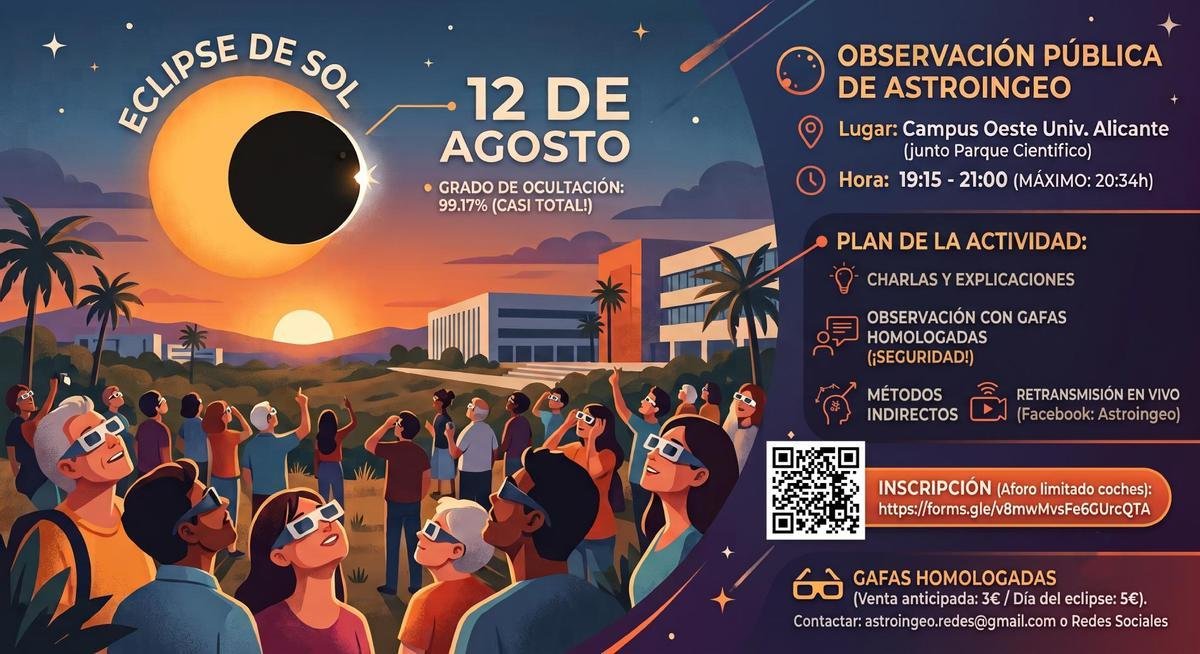
On the evening of Wednesday, August 12, 2026, the Alicante region will experience a spectacular astronomical event: a deep partial solar eclipse. Although the city of Alicante is just south of the path of totality, preventing a 100% total eclipse view, the obscuration will reach an incredible magnitude of 0.99, meaning the Moon will cover over 95% of the Sun’s surface. This will cause a dramatic drop in ambient light, creating a stunning effect similar to a total eclipse. This celestial event will peak at sunset, offering observers a unique view of the Sun as a slender crescent sinking into the twilight.
Key Viewing Times and Location Selection
According to precise data from Spain’s National Geographic Institute (IGN), the key times for the eclipse in the Alicante and San Vicente del Raspeig areas are as follows:
- 19:40:08: Eclipse begins (first contact), as the Moon starts to move across the Sun’s disk.
- 20:34:35: Maximum eclipse (greatest phase) is reached, with the Sun at an altitude of only 4 degrees above the horizon.
- 20:59:00: Sunset, with the Sun setting while still partially eclipsed.
Because the maximum eclipse occurs when the Sun is very low, it is crucial for observers to find a location with a completely clear, unobstructed view of the western and northwestern horizon, free from buildings, mountains, or trees. This is the single most important factor for a successful viewing experience.
University of Alicante’s Free Public Viewing Event
To help the public observe this event safely and scientifically, the University of Alicante’s Astronomy Association, Astroingeo, will organize a free public viewing on campus. The details are as follows:
- Time: August 12, 2026, from 19:15 to 21:00.
- Location: Next to the west-facing main wall of the Science Park (Parque Científico) building on the University of Alicante’s San Vicente Campus (Campus de San Vicente).
- Activities: Several professional electronic telescopes will be available, with astronomers providing live commentary to help attendees understand the eclipse process.
- Attendance: The event is free. However, official online registration is already full, and no parking is available at the event site. Interested members of the public can park further away or use public transport and walk to the viewing area.
Important Safety Warning: How to View the Eclipse Correctly
Even when the Sun is mostly covered, its remaining light is intense enough to cause permanent eye damage (retinal burns). Strict safety measures must be taken to observe a solar eclipse.
- Use certified solar viewing equipment: Observers must use special-purpose solar eclipse glasses that comply with the ISO 12312-2 international safety standard. Regular sunglasses, no matter how dark, are not safe for viewing the Sun.
- Never look through unfiltered optical instruments: It is absolutely forbidden to look at the Sun directly through a telescope, binoculars, or camera lens without a professional solar filter securely attached to the front. Likewise, do not look through an unfiltered optical instrument while wearing eclipse glasses, as the concentrated solar rays will burn through the filter and cause severe eye injury instantly.
