A Celestial Event of the Century: The August 12, 2026 Total Solar Eclipse Overview
In the summer of 2026, a truly once-in-a-generation astronomical spectacle will unfold in Spain. According to astronomers’ predictions, on August 12, 2026, a major total solar eclipse will traverse the country. At that time, the Moon will align perfectly between the Earth and the Sun, casting its shadow over parts of the Iberian Peninsula. This will briefly turn day into night and reveal the Sun’s rarely seen corona in the sky. This total solar eclipse is considered one of the most significant astronomical events in Spain since the early 20th century, highly anticipated for its spectacular nature and wide visibility.
Path of Totality and Viewing Areas
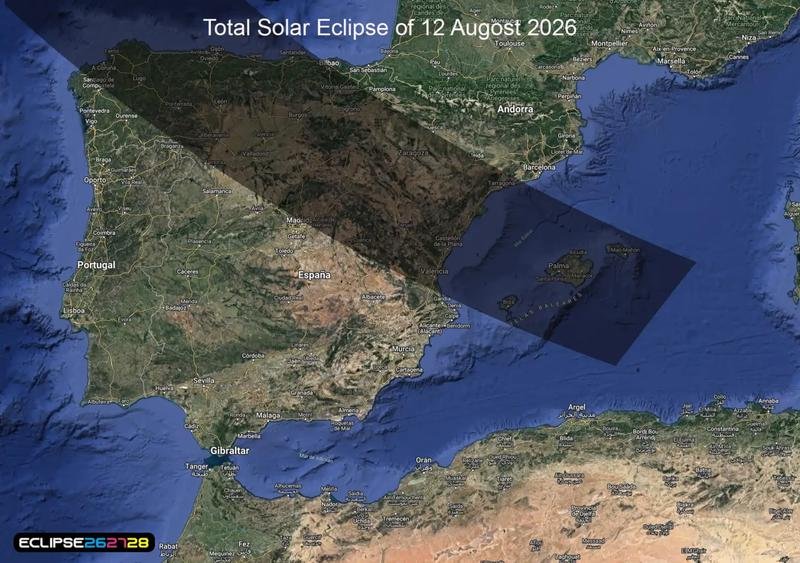
The “path of totality,” the area where the Sun will be completely obscured, will stretch from the northwestern region of Galicia eastward, passing through Castile and León, Madrid, Castile-La Mancha, Aragon, Catalonia, and the Balearic Islands. Cities and residents within this band will have the privilege of witnessing the full total solar eclipse. While other regions of Spain are outside the path of totality, they will still experience a partial solar eclipse to varying degrees. Given that the eclipse occurs in the peak of summer in August, the probability of clear skies across most of Spain is high, providing ideal natural conditions for observation.
Spain’s Eclipse “Trilogy” and Long-Term Outlook
What’s more remarkable is that the 2026 eclipse is not an isolated event; it kicks off an “eclipse season” for Spain spanning three consecutive years. From 2026 to 2028, Spain will experience three significant solar eclipses, making the country a global focus for astronomical observation. Among them, the total solar eclipse on August 12, 2026, is undoubtedly the most valuable for viewing. Records show that if you miss this opportunity, the next total solar eclipse in Spain will not occur until 2053. This means for many, it may be the only chance to see a total solar eclipse in the country for nearly three decades.
Official Information and Viewing Safety
To help the public better prepare for this astronomical feast, official Spanish institutions, the National Geographic Institute (Instituto Geográfico Nacional, IGN) and the National Astronomical Observatory (Observatorio Astronómico Nacional, OAN), have jointly released information and launched online tools. Through these official channels, the public can find out if their city is in the path of totality, the specific start time and duration of the eclipse, and information on the best viewing spots.
Astronomers specifically emphasize that strict safety measures must be taken when observing a solar eclipse. Under no circumstances should you look directly at the Sun with the naked eye or through non-specialized equipment like regular sunglasses or telescopes, as the intense sunlight can cause permanent retinal damage. The correct way to observe is by using certified eclipse glasses that meet the ISO 12312-2 international safety standard or professional solar filters.
Planning Your Viewing Trip
Given the rarity and high interest in this total solar eclipse, a large influx of astronomy enthusiasts and tourists is expected to flock to the best viewing locations within the path of totality. Therefore, it is advisable for those planning to watch the event on-site to plan their itinerary and book transportation and accommodation well in advance to avoid any disruption to their experience due to high demand. Keeping a close watch on weather forecasts and having a backup observation plan are key to successfully witnessing this astronomical wonder.
