France Grapples with Dual Crisis of Extreme Heat and Wildfires, Macron Calls it Gravest Challenge Since WWII
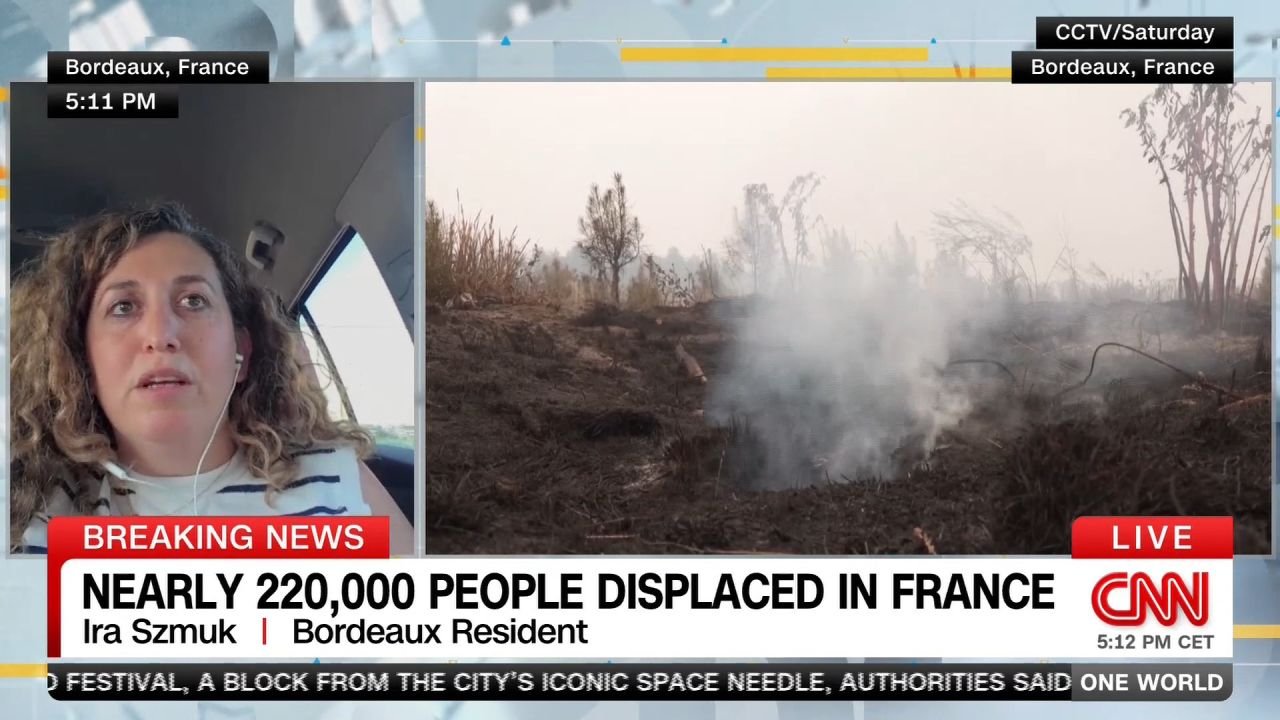
This summer, the European continent has been continuously blanketed by extreme high temperatures, with France particularly caught in a scorching ordeal. The successive heatwaves have not only accelerated the melting of glaciers in the Alps but have also sparked the country’s most severe fire crisis since World War II in southwestern France. While visiting the disaster area, French President Emmanuel Macron stated that France is facing an unprecedented challenge.
Unprecedented Wildfires: Gironde Turned to Ash, Defense Industry Sites Threatened
The southwestern region of France has become the epicenter of this fire disaster. According to statistics, as of July 27, the area burned in the Gironde department alone had exceeded 42,000 hectares, equivalent to four times the size of Paris. During a visit to a firefighting command center, President Macron described the blaze as ‘the most severe fire crisis France has faced since the end of World War II.’ From the start of summer to the end of July, more than 13,000 fires have been recorded across France, with the total burned area exceeding 116,000 hectares.
The spread of the fires posed a direct threat to France’s vital defense industry. The town of Saint-Médard-en-Jalles, near Bordeaux, is home to France’s second-largest defense industry cluster, including ArianeGroup’s M51 ballistic missile propellant loading facility and a subsidiary of the European missile company MBDA. As the flames approached, facilities belonging to several defense companies, including Dassault Aviation, Thales, and Safran, were forced to evacuate personnel and transfer sensitive equipment.
Human Factor Behind the Natural Disaster: From Arson by a Firefighter Volunteer to Construction Negligence
Investigations have revealed that in addition to weather conditions, human factors played a key role in several fires. In the Fontainebleau forest near Paris, an investigation into a fire that destroyed over 2,000 hectares of woodland identified six suspects, one of whom was a volunteer firefighter. The volunteer admitted to using a lighter and gasoline to set branches on fire, while others started fires by carelessly discarding cigarette butts. In response, President Macron stated on-site that there would be ‘zero tolerance’ for arson.
Furthermore, another fire in the Fontainebleau forest was caused by negligent construction work. Sparks from an angle grinder used by workers repairing highway guardrails ignited dry grass on the roadside, with the fire eventually spreading to the forest. Against the backdrop of a months-long drought, surface vegetation is extremely flammable, and even the smallest spark can lead to a major disaster.
A Trial of Ice and Fire: Alpine Glacier Melt and Europe’s Response
While southwestern France was being consumed by fire, the glaciers of the Alps were also in peril due to the persistent high temperatures. A rising snow line has caused extensive snowmelt, exposing dangerous crevasses and unstable rock faces. Karrer, head of training at the Swiss Alpine Club, warned that many traditional mountaineering routes have become exceptionally dangerous.
The impact of this extreme weather event has been felt across Europe. The Spanish government declared a national state of emergency for the first time due to wildfires, with 32,000 hectares burned in the central province of Guadalajara. Portugal and Italy are also facing severe fire situations. To address the crisis, the European Union has activated its Civil Protection Mechanism, deploying nearly twenty aircraft and hundreds of firefighters to support France and Spain.
The Harsh Reality of Climate Change: “Compound Droughts” and “Pyrocumulonimbus” Clouds
A rare meteorological phenomenon appeared during this disaster: the ‘Pyrocumulonimbus’ cloud. French wildfire researcher Filippi pointed out that this type of thunderstorm cloud, generated by the fire itself, can have updrafts exceeding 150 kilometers per hour and can trigger new lightning strikes, igniting new fires elsewhere and making firefighting efforts significantly more difficult. NASA has described it as ‘a fire-breathing dragon of a cloud.’
The international research group World Weather Attribution has analyzed that Europe is experiencing a ‘compound drought,’ caused by the combination of long-term drought and extreme heat. This has had profound effects on agriculture, drinking water supplies, inland navigation (such as the sharp drop in water levels on the Rhine and Meuse rivers in the Netherlands), and electricity supply. Scientists widely agree that these phenomena are clear signals of accelerating global climate change.
