Spain’s Future Demographics Reshaped: Immigration Fuels Growth, Southeast Becomes New Focal Point
According to the latest long-term population projection report released by the National Statistics Institute (Instituto Nacional de Estadística, INE), Spain is undergoing a profound demographic transformation. The report indicates that from now until the beginning of 2041, the country’s population growth will be driven entirely by foreign immigration, while the native-born population is projected to continue its decline.
15-Year Demographic Forecast: Immigration as the Sole Engine of Growth
Data shows that over the next 15 years, Spain’s total population is expected to increase by approximately 4.25 million, reaching nearly 54 million by 2041. However, this growth will not stem from natural increase. During the forecast period, the native-born population is projected to decrease by 1.8 million. In stark contrast, over 6 million foreign-born individuals are expected to immigrate to Spain during the same period.
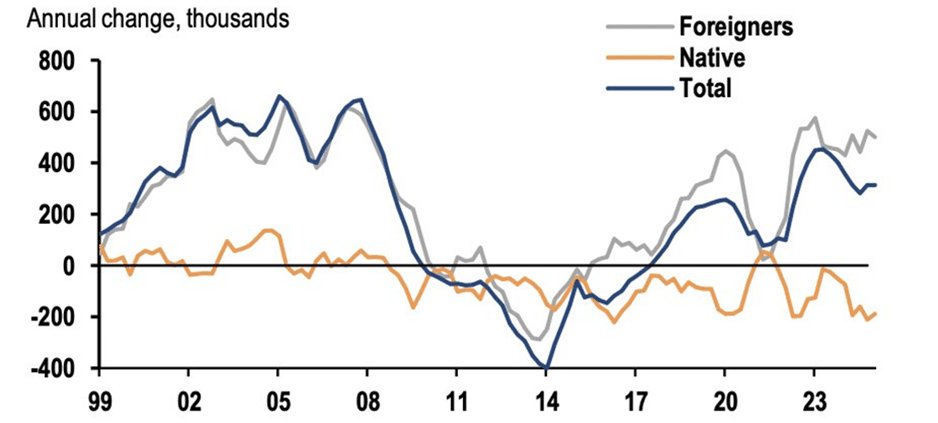
This powerful wave of immigration will not only completely offset the decline in the native population but will also be the decisive force driving overall population growth. By then, the total number of foreign-born residents is expected to reach 16.1 million, accounting for nearly 30% of Spain’s total population.
The Rise of Two Southeastern Autonomous Communities: Attracting One-Fifth of New Immigrants
In this nationwide demographic shift, the southeastern autonomous communities of the Valencian Community (Comunitat Valenciana) and the Region of Murcia (Región de Murcia) will play a pivotal role. Data indicates that the Valencian Community is projected to have the highest population growth rate in the country, with an increase of 16.4%, bringing its total population to 6.4 million by 2041.
The population growth in the Region of Murcia is also robust, with a projected increase of 12.2%, ranking fifth nationally, which will bring its total population to 1.8 million. Combined, these two communities are expected to attract a total of 1.16 million new foreign-born residents, accounting for nearly one-fifth of Spain’s total new immigrants over the next 15 years. This data clearly indicates that the southeastern region is becoming a popular destination for foreign populations to settle.
Stark Contrast Between Native Population Change and Immigrant Growth
A deeper analysis of the demographic composition of these two communities reveals that their growth is almost entirely dependent on the foreign population. In the Valencian Community, the native-born population is projected to see a net decrease of 62,500 by 2041. Meanwhile, in the Region of Murcia, although the native-born population will see a slight increase of about 1,600, it is almost negligible compared to the massive influx of immigrants. This stark contrast once again confirms the indispensable role of foreign immigration in maintaining regional vitality and achieving population growth.
Population Growth Accompanied by a Deepening Aging Trend
Alongside the overall population increase, population aging is an undeniable trend. According to INE’s forecast, by 2041, the average age of Spain’s national population will rise by nearly 3 years from its current level, reaching 44.7 years.
This trend is also significant in the Valencian Community and Murcia. The average age of residents in the Valencian Community is expected to climb from 44.4 to 47 years. Meanwhile, in the Region of Murcia, known for its relatively younger demographic structure, the average age will also increase from the current 42.1 to 45.3 years. This indicates that even in regions with rapid population growth, social aging will remain a shared challenge to be addressed in the future.
