Spain’s Ceuta Border Crisis: Nearly 49,000 Migrants Arrive, Sparking EU Controversy
Spain’s autonomous enclaves in North Africa, Ceuta and Melilla, are facing an unprecedented border crisis. Since late July 2026, tens of thousands of migrants have poured in from Morocco, posing a severe challenge to border management for Spain and the entire European Union.
Record Migrant Wave Hits Ceuta
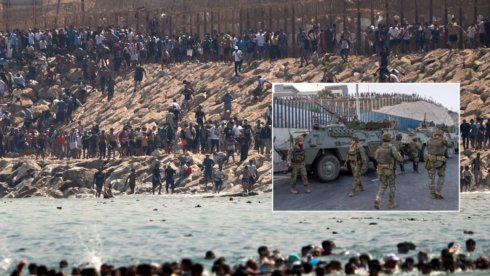
According to Spain’s Civil Guard (Guardia Civil), the number of migrants entering Ceuta since last weekend has approached 49,000. This figure far exceeds the previous record of about 12,000 arrivals in 2021. Large numbers of migrants, including entire families, youths, and children, have entered Spanish territory by climbing the border fence or swimming around the breakwaters.
The event has resulted in tragic loss of life. To date, authorities have confirmed that 19 individuals died during the attempt to enter, with their bodies discovered at the scene and along the coast.
Spain’s Emergency Military and Administrative Response
Facing an out-of-control situation, the President of the Autonomous City of Ceuta, Juan Jesús Vivas, made an urgent appeal to Spain’s central government. In response, Madrid activated the highest level of emergency measures. Prime Minister Sánchez personally visited the site and ordered the closure of the border crossing in Melilla.
The central government has urgently deployed Spanish Army units to Ceuta to assist the Civil Guard and National Police in enforcing the border blockade and control measures. Under this strong military and police presence, by Friday morning, hundreds of recently arrived migrants had begun to voluntarily return to the Moroccan side.
The Complex Triggers Behind the Crisis
This migrant surge was not accidental. Investigations reveal that calls began circulating on Moroccan social media at least a week prior, falsely claiming that ‘July 30 is the final deadline to enter Spain.’ This misinformation prompted a large number of people, especially young individuals, to attempt the crossing without informing their families.
Furthermore, a recent ruling by Spain’s Supreme Court is also considered a key factor. The ruling clarified that the legally permitted ‘express returns’ apply only to individuals intercepted at land border infrastructure, such as the fence, but not to those who enter by swimming from the sea. This legal ‘loophole’ was exploited by smuggling networks, acting as a catalyst for the large-scale sea crossing attempt.
EU-Wide Repercussions and Diplomatic Fallout
The Ceuta border crisis has quickly triggered a chain reaction within the European Union. With a large number of migrants entering the Schengen Area, Spain’s EU partners have expressed concern and applied pressure. France has already tightened controls on its border with Spain.
More drastic reactions have come from Italy and Finland. The Italian government is considering the possibility of suspending the Schengen Agreement, while Finland has openly supported the proposal to temporarily ‘kick Spain out of the Schengen Area.’ This border crisis is escalating into a serious diplomatic fallout within the EU, testing the solidarity of member states and the stability of the Schengen system.
