Record Influx and Overwhelmed Border
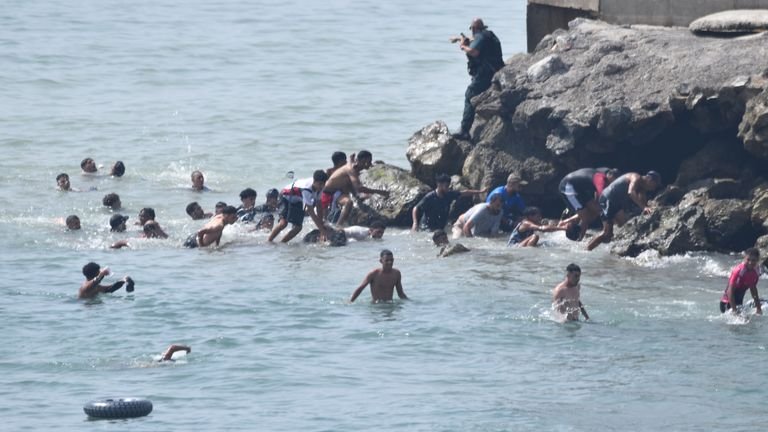
On July 30, the Spanish autonomous city of Ceuta in North Africa experienced a massive influx of migrants. According to preliminary data released by the Spanish police union Jupol, over 20,000 migrants entered Ceuta from neighboring Morocco on that day. If officially confirmed, this figure would be double the scale of the 2021 Ceuta migrant crisis, marking one of Spain’s most severe border challenges this century. Large numbers of people entered Spanish territory by swimming around the maritime border or walking along the Tarajal border breakwater, overwhelming the stationed Civil Guard, who temporarily lost control of the situation. In recent days, maritime rescue services have recovered at least 15 bodies from nearby waters, believed to be victims who tragically drowned while attempting to swim to shore.
Government’s Emergency Response and Military Deployment
Faced with the rapidly deteriorating situation, all political parties in the Ceuta assembly have jointly appealed to the central government. In response, the Spanish government ordered the deployment of additional military forces to the border to help the Civil Guard reinforce control. Meanwhile, Prime Minister Pedro Sánchez and Interior Minister Fernando Grande-Marlaska are scheduled to visit Ceuta on July 31. The President of Ceuta, Juan Jesús Vivas, described the local situation as an ‘absolute humanitarian and social emergency’ and requested the central government to declare a national state of emergency. However, Madrid has stated that the current legal framework for a state of emergency does not apply to managing migration flows. Concurrently, Spain has begun coordinating with Morocco to expedite repatriation procedures for those who have entered Ceuta.
Overloaded Reception System and Humanitarian Pressure
This large-scale influx has placed immense pressure on Ceuta’s public services. Reception centers for both adults and minors are severely overloaded. Specifically, shelters for unaccompanied minors have reached 200% of their designed capacity. A large number of migrants who cannot be accommodated are forced to sleep on the streets, further exacerbating the city’s humanitarian situation. Many migrants arrive exhausted after swimming for hours, in desperate need of medical care and basic assistance, posing a significant challenge to local rescue and settlement efforts.
Blame and Repatriation Controversy
Regarding the cause of the crisis, both the Spanish and Moroccan governments have pointed to organized human trafficking networks. They believe criminal groups exploited a recent Spanish Supreme Court ruling on border returns to incite and organize this large-scale smuggling operation. Morocco has pledged to increase cooperation and denied allegations of deliberately allowing illegal immigration. However, some Spanish police unions have criticized Moroccan authorities for failing to effectively stop the flow of people to the border, citing lax control. In terms of response, the Spanish Commission for Refugee Aid (CEAR) has warned against the collective repatriation of all arrivals to Morocco without individual assessment, stressing that such an act could violate the internationally protected right to seek asylum and has called on authorities to evaluate each case independently.
