Wildfires Devastate Spain, Putting Real Estate Market to a Severe Test
As summer heatwaves sweep across Spain, the prolonged high temperatures have dramatically increased the risk of forest fires. According to data as of August 3, 2026, the cumulative burned area within Spain this year has approached 225,000 hectares. The province of Ávila and the Community of Madrid have emerged as the most severely affected regions, where the fires have not only consumed vast forest lands but also dealt a devastating blow to the local real estate market.
Staggering Property Losses: Nearly 1,600 Homes Affected
According to preliminary damage assessments, 1,580 homes have been affected within the fire-impacted zones of Madrid and Ávila alone. The total market value of these properties is a staggering €343.9 million. The report indicates that if all damaged homes were to require complete repair or reconstruction, the estimated cost would reach an astonishing €157.1 million. Due to its higher population and property density, the Community of Madrid bears the majority of these potential reconstruction costs.
Government’s Emergency Response: Community of Madrid Allocates €100 Million
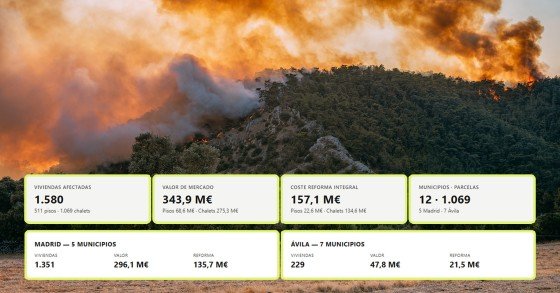
Facing the severe disaster and the high cost of rebuilding, the government of the Community of Madrid has acted swiftly. The regional president, Isabel Díaz Ayuso, has publicly announced an emergency allocation of €100 million, specifically earmarked for post-disaster recovery and reconstruction efforts. To raise additional funds, the regional government also plans to sell five of its official properties, expecting to generate an extra €20 to €22 million. For one of the hardest-hit municipalities, San Martín de Valdeiglesias, property restoration costs are projected to run into the tens of millions of euros.
Profound Long-Term Impacts: A Double Blow to the Economy and Market
The impact of this wildfire crisis extends far beyond the physical destruction of homes. In the long run, the disaster will have profound consequences for the regional economy and society. Firstly, property values in and around the burned areas face a significant risk of depreciation. Secondly, the large-scale disaster will trigger complex insurance claims and could lead to future premium hikes. Lastly, for many small towns whose economies rely on holiday homes and tourism, the destruction of properties and the ecological damage mean that economic recovery will be a long and arduous challenge.
