Overview and Global Path of the 2026 Total Solar Eclipse
On August 12, 2026, a rare astronomical event—a total solar eclipse—will occur, with Spain being one of the few land areas worldwide where it can be viewed in its entirety. The eclipse path begins near the Bering Strait, crosses northeastern Greenland and the westernmost tip of Iceland, before entering the Iberian Peninsula and finally ending in the Atlantic Ocean. During this time, the Moon will complete its full cycle from first contact, through totality, to last contact in approximately 4 hours and 30 minutes. Northern North America, most of Europe, and western Africa will only experience a partial solar eclipse.
Path of Totality Across Spain
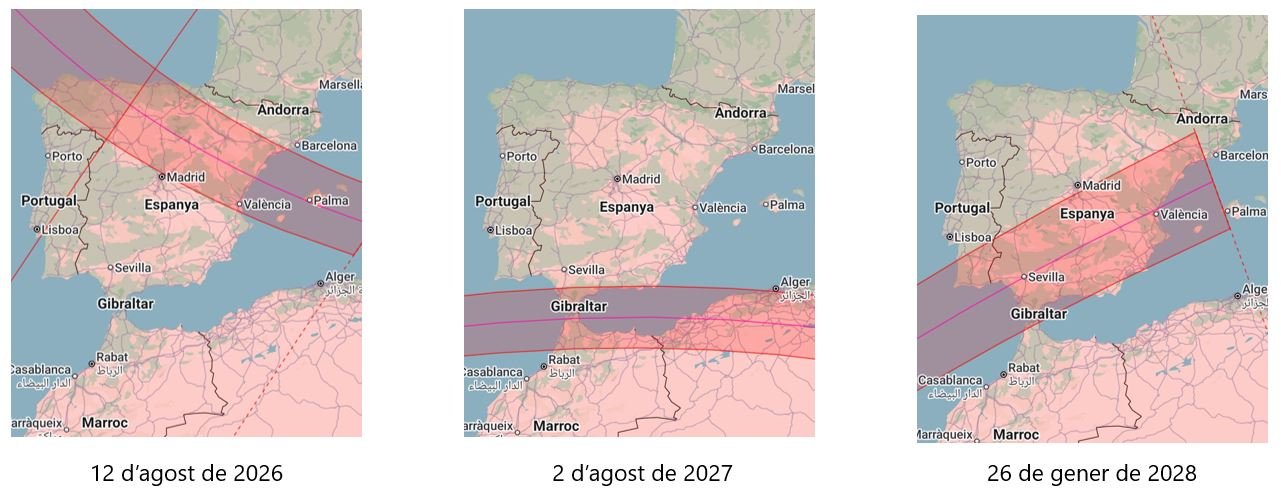
Within Spain, the path of totality will move from west to east, starting in the region of Galicia and crossing Asturias, Cantabria, Castile and León, the Basque Country, Aragon, Catalonia, the Valencian Community, and finally ending in the Balearic Islands. The centerline, where the duration of totality is longest, will pass near places like Avilés, Oviedo, Soria, Peñíscola, and Palma de Mallorca. While southern Spain lies outside the path of totality, it will still witness a very deep partial solar eclipse.
Viewing Timetable for Major Cities
Over 20 provincial capitals across Spain will be able to observe the total solar eclipse, including A Coruña, Lugo, Oviedo, Santander, Bilbao, Burgos, Zaragoza, Valencia, and Palma.
The time of totality (when the Sun is completely obscured) will vary slightly by location, generally occurring between 8:27 PM and 8:33 PM local time. Here is a reference for some cities:
- A Coruña: The eclipse is expected to begin at 7:31 PM, with totality reached at 8:28 PM.
- Burgos: It will start around 7:33 PM, reach totality at 8:29 PM, and the entire event will last until sunset at 9:20 PM.
- Palma: As one of the last places in Spain to see the total eclipse, it is expected to begin at 7:38 PM, reaching totality at 8:32 PM.
Official Viewing Advice and Safety Notice
According to information jointly released by the Spanish Ministry of Transport and Sustainable Mobility (Ministerio de Transportes y Movilidad Sostenible) and the National Geographic Institute (Instituto Geográfico Nacional), because the eclipse occurs near sunset, viewers are advised to find a high-altitude location with a clear, unobstructed view to the west in advance.
The most critical aspect is viewing safety. Never look directly at the sun with the naked eye without any protection. Regular sunglasses are not sufficient. To observe the eclipse, you must use special-purpose solar filters, such as certified eclipse glasses that meet international safety standards. Improper viewing can cause permanent, irreversible damage to the retina.
