1. Border Overrun: Tens of Thousands Flood Europe’s ‘Enclave’
Ceuta, a Spanish autonomous city on the northern tip of Africa, has long been considered the ‘southern gateway’ to Europe due to its unique geographical location. Recently, this gate was suddenly forced open.
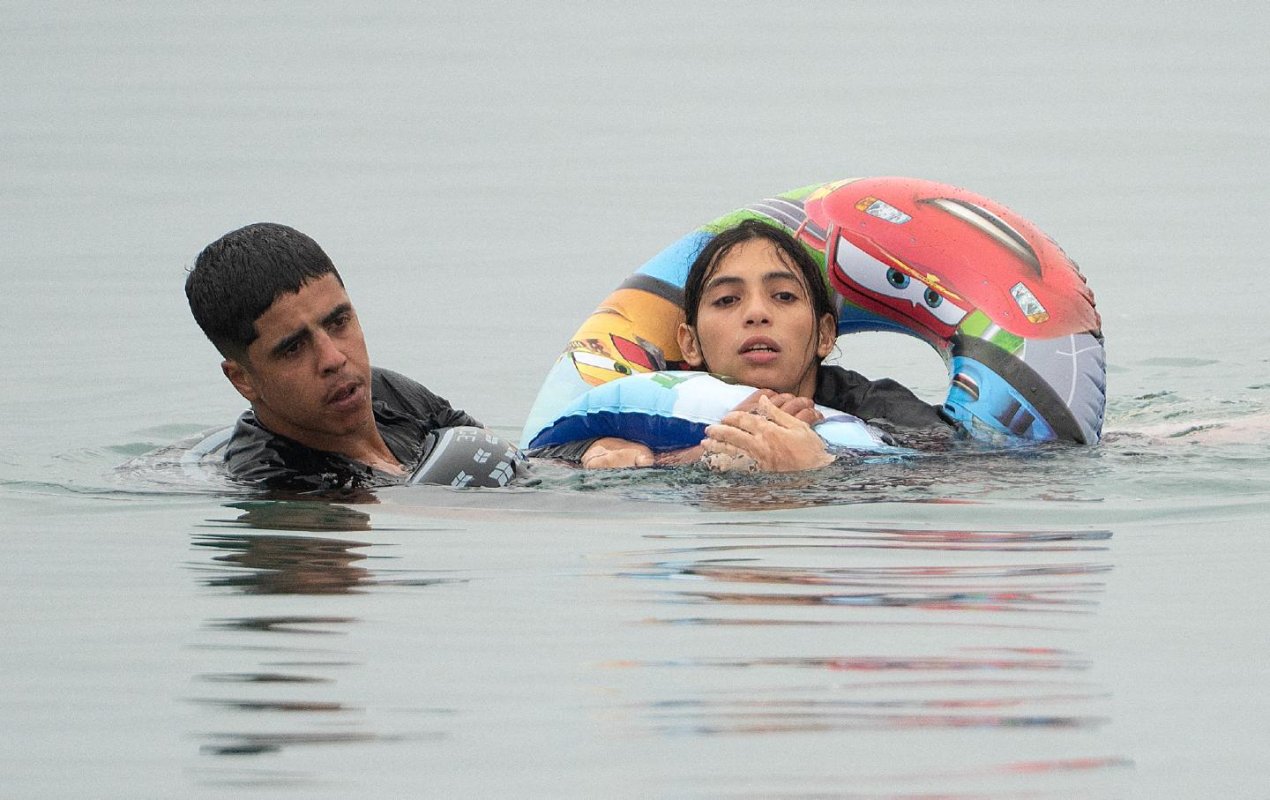
According to on-site observations by independent journalist Nick Shirley, an unprecedented wave of migration suddenly erupted around July 31st. By his unofficial estimates, the number of people crossing the border could be as high as sixty thousand. Large groups of migrants used makeshift flotation devices, or even just their bare hands to swim, bypassing the border breakwater, or walking onto Spanish territory during low tide. Although Spanish authorities urgently deployed the army and police and carried out immediate deportations for some, thousands of migrants remain stranded in Ceuta, overwhelming the small city.
2. Migrant Profile: Young Men and Minors Seeking Opportunity
This migration wave exhibits distinct demographic characteristics. On-site footage shows that the vast majority of those crossing are young men and underage boys from neighboring Morocco, with almost no women. Among them, a large number of unaccompanied minors aged between 13 and 17 are particularly concerning.
When asked about their motivation for crossing, these young people’s answers commonly point to a desire for a better future. They state that they face unemployment, poverty, and a lack of education in Morocco, and hope to pass through Spain to eventually reach major European cities like Madrid or Paris to find work and a better life. As for the absence of women, one migrant explained that according to some local cultural norms, men are the ones who go out to make their way in the world, while women stay at home.
3. Dire Living Conditions: City Resources Depleted, Cemetery Turned into a Bathhouse
The massive influx of migrants has rapidly depleted Ceuta’s public services and relief capacity. With reception centers long past saturation, a large number of migrants are forced to sleep on the streets. To evade police patrols, many hide in the bushes and forests on the city’s outskirts or curl up under parked cars at night.
The harsh living conditions have led to shocking scenes. It has been reported that groups of migrants have occupied a public cemetery, where they broke into the underground water pipe system to get water, bathing and washing their clothes directly beside tombstones, highlighting the severity of this humanitarian crisis.
4. Local Panic: ‘Stick-Wielding Patrols’ and Business Shutdowns
The sudden influx of migrants has caused immense social panic in Ceuta, a city with a population of only about eighty thousand. With streets filled with large groups of young male migrants, local female residents report feeling extremely unsafe, even being afraid to take their children outside. At the height of the crisis, to prevent robberies and riots, all shops in the city center, including supermarkets and pharmacies, chose to close, bringing the daily life of residents to a standstill.
Facing what they perceived as a slow official response, some local residents began to organize patrols themselves. Due to Spain’s strict gun control laws, these individuals patrol the streets wielding wooden sticks, even carrying them for self-defense while jogging, forming what has been dubbed ‘stick-wielding patrols.’
5. The Political Chess Game: An Allegedly ‘Permitted’ Crisis and Policy ‘Pull Factors’
This seemingly sudden humanitarian crisis involves a complex political game. Many local residents in Ceuta and some migrants suspect that such a large-scale, organized border crossing would be nearly impossible without the ‘tacit approval’ of Moroccan authorities. Some migrants even told reporters that ‘the Moroccan police let them come.’
Meanwhile, Spain’s own immigration policies are also considered a significant ‘pull factor.’ In April, before the crisis, the government of Prime Minister Pedro Sánchez proposed a plan to regularize the status of some 500,000 undocumented immigrants. This policy was criticized for sending the wrong signal to potential illegal immigrants. On the ground, numerous Moroccan migrants were heard chanting ‘Viva Pedro Sánchez’ (Long live Pedro Sánchez), confirming the policy’s appeal. Critics suggest this may be a strategy for politicians to secure future votes, but it has inadvertently intensified the pressure on the border.
Currently, the situation in Ceuta remains tense. On one side are migrants struggling to survive, and on the other, residents filled with fear and anger. As revealed by journalist Nick Shirley’s personal experience of being pelted with stones and even chased with a knife in the city center, this border enclave is on the verge of conflict and danger.
