Reception Capacity Severely Overloaded, System Faces Collapse
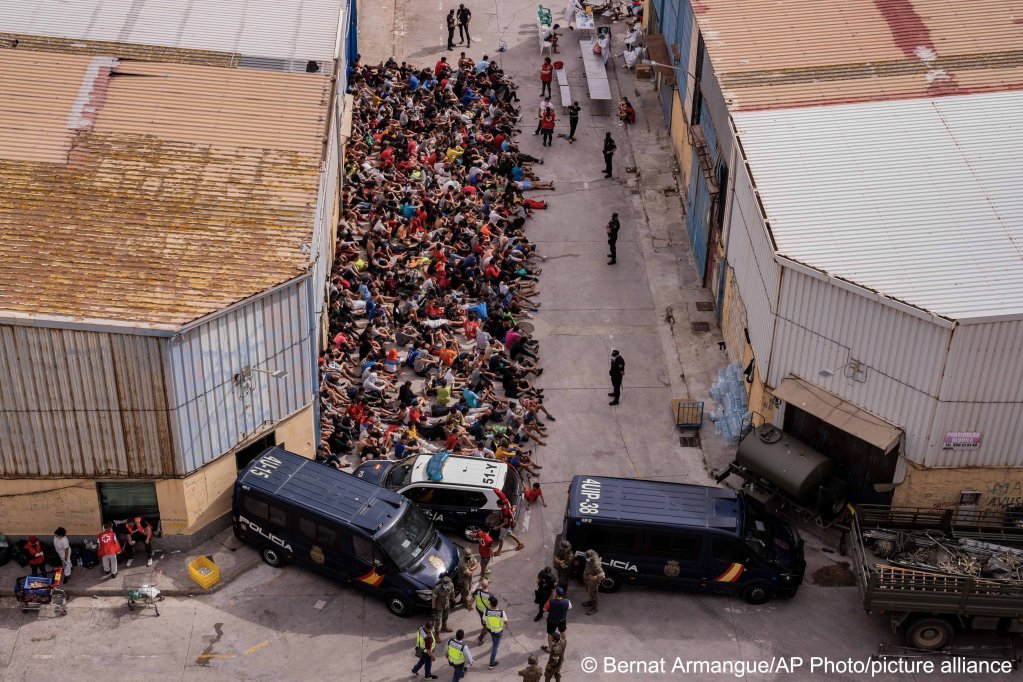
The Spanish autonomous city of Ceuta in North Africa is facing an unprecedented reception crisis for minor migrants. According to the local government, approximately 1,000 unaccompanied minors have entered the child protection system following recent mass border crossings. However, this number far exceeds the region’s capacity.
Under the plan established by Spain’s Ministry of Youth and Children, Ceuta’s regular reception capacity is just 29 beds. The current influx has pushed occupancy to over 30 times its normal capacity, causing several facilities to approach total collapse. These minors are currently being housed temporarily at the La Esperanza reception center, a warehouse in the Tarajal area, and two temporary sites in Piniers. To alleviate the pressure, the Ceuta government is planning to open two schools as temporary shelters, expected to provide about 500 additional spots. Child protection organizations also warn that many minors remain on the streets or hidden in the mountains, suggesting the actual number needing aid could be higher.
Central Government Provides Emergency Funds Amid Regional Disagreement
To address the crisis, the Spanish central government has announced €25 million in emergency funding for Ceuta to improve accommodation, food, medical care, and mental health support for these minors. This aid is in addition to the €5.5 million allocated in July.
Meanwhile, the central government is considering activating an emergency relocation mechanism under the Foreigners’ Law (Ley de Extranjería), planning to transfer some minors to other autonomous communities on the Spanish mainland within 15 days to share responsibility. However, this proposal has met with explicit opposition from several regions governed by the People’s Party (PP) or a PP-Vox coalition, including Madrid, Castile and León, Aragon, and Extremadura. These regional governments argue that border management is a central government responsibility and the burden should not be shifted to them.
A Dual Legal and Humanitarian Challenge
This crisis not only tests Spain’s reception capacity but also highlights its legal and humanitarian complexities. Under Spanish law, unaccompanied minor migrants cannot be immediately repatriated like adult irregular migrants. Any decision to return them to their country of origin must undergo a rigorous individual assessment, always prioritizing the ‘best interests of the minor’.
Immigration experts stress that every arriving minor must undergo careful identity verification, including recording their name, age, nationality, language, and collecting fingerprints and photos. For adolescents whose age is difficult to determine, it is crucial to provide translators, adequate housing, and professional psychological support to avoid mistakenly classifying a true minor as an adult, which would strip them of their legal protections. Currently, the immediate priority for humanitarian efforts is to identify all displaced minors and move them to safe locations.
