2026 Total Solar Eclipse in Spain: A Celestial Spectacle Mobilizes the Nation
On August 12, 2026, Spain will witness an exceptionally rare astronomical phenomenon: the first total solar eclipse visible from the mainland in nearly a century. This event has not only captured the attention of astronomy enthusiasts worldwide but also presents a massive opportunity and challenge for Spain’s tourism industry. With hundreds of thousands of visitors expected, Spanish authorities are mobilizing to ensure the event is both smooth and safe.
Astrotourism Boom and Economic Projections
According to projections from Spain’s Ministry of Economy, the total solar eclipse is expected to draw approximately 446,700 additional tourists to the 36 provinces within the path of totality during the week of August 10-16. This tourism surge is forecast to generate a net economic impact of around €347.6 million. Google search data reveals that Spain is the third most interested country in the eclipse globally, with cities like Palma, Zaragoza, Valencia, Bilbao, and Barcelona ranking among the top search hotspots worldwide.
Multi-Agency High-Level Security Activation
To manage the massive crowds and potential emergencies, Spain’s Ministry of the Interior has activated a Unified Command Center (PMU) to coordinate the efforts of the National Police, the Civil Guard (Guardia Civil), the Directorate-General for Traffic (DGT), and Civil Protection services. The DGT has already begun displaying special alerts on highway information panels, advising drivers to turn on their low-beam headlights, maintain a safe distance from the vehicle ahead, and strictly refrain from using phones or other devices to photograph the eclipse while driving to prevent accidents. Significant traffic congestion is expected on roads leading to prime viewing locations.
Preventing Secondary Disasters and Local Regulations
August is Spain’s dry season, raising significant concerns about fire risks due to large crowds gathering in natural areas. Minister for Ecological Transition, Sara Aagesen, has publicly urged the public to exercise “extreme caution” when observing the eclipse in the countryside.
Autonomous communities have also implemented strict control measures:
- Castilla-La Mancha: An additional 1,000 Civil Guard officers and 300 National Police officers will be deployed to enhance security and patrols.
- Valencian Community: To mitigate fire risks, all natural parks within the region will be closed during the eclipse.
- Community of Madrid: The eclipse is expected to generate around 500,000 trips. The phenomenon will be visible in 93 municipalities in the region, with 66 of them having officially recommended viewing spots.
Viewing Guide and Safety Reminders
The total solar eclipse will begin around 20:30 local time, with the phase of totality lasting up to 1 minute and 50 seconds. During this time, the sky will darken, the magnificent solar corona will become visible, and bright planets like Venus and Jupiter may also be seen with the naked eye.
To ensure public safety, official and private organizations are providing various forms of support. The Ministry of Science and Innovation, in collaboration with the Spanish Foundation for Science and Technology (FECYT), has launched an interactive website to help people find the best viewing locations. Some airlines are even offering “eclipse flights” for passengers to experience the spectacle from high altitudes.
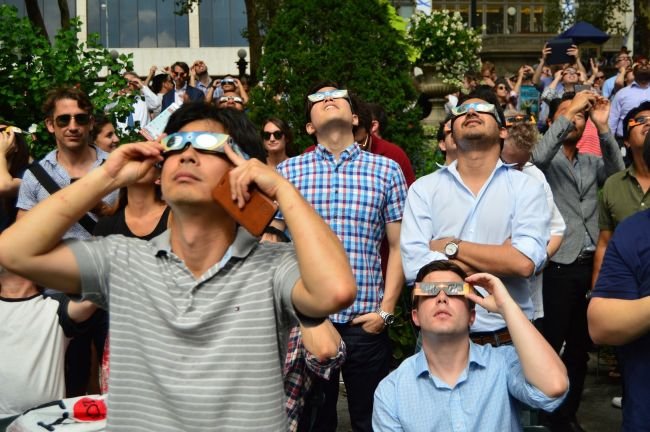
However, safety is a major concern. The consumer organization FACUA has issued a recall for six models of eclipse viewing glasses (including brands like Lionstar and ECP) due to serious safety risks. Their filters are excessively dark, which could lead users to look directly at the sun without protection while adjusting the glasses, causing permanent eye damage. Meanwhile, the 50,000 free certified glasses distributed by the Madrid City Council and the 2 million by the central government have been nearly all claimed. Authorities strongly advise the public to use only certified, professional equipment for viewing.
