After the total solar eclipse on August 12, 2026, captured the nation’s attention, astronomy enthusiasts in Spain won’t have to wait long for the next celestial shows. Over the following two years, Spain will host two more significant solar eclipses: a rare, exceptionally long total solar eclipse and a spectacular annular solar eclipse.
August 2, 2027: The Great Total Solar Eclipse
According to information from Spain’s National Geographic Institute (Instituto Geográfico Nacional), the next total solar eclipse will occur on August 2, 2027. The highlight of this event is its remarkable duration: the phase of totality will last for an impressive 6 minutes and 23 seconds, making it one of the longest total solar eclipses worldwide for the next 157 years.
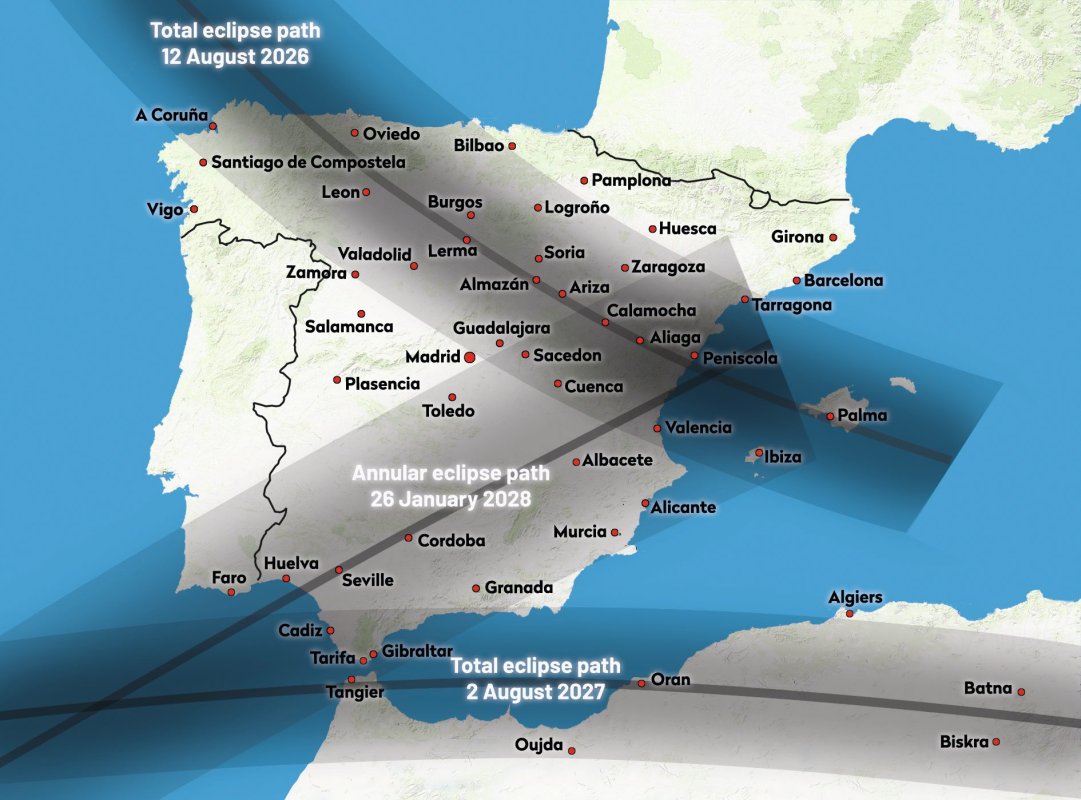
Spain will be the only country in Europe where the total eclipse is visible. The path of totality will cross the southern part of the country, with the best viewing areas covering Ceuta, Melilla, nearly all of the province of Cádiz, most of Málaga, and the southernmost tips of Granada and Almería in Andalusia. The rest of Spain will experience a partial solar eclipse with a very high magnitude.
Globally, the eclipse’s path will begin in the Atlantic Ocean, cross the Strait of Gibraltar and North Africa, extend through Egypt, the Red Sea, parts of Saudi Arabia and Yemen, and finally end in the Indian Ocean.
January 26, 2028: A ‘Ring of Fire’ Over the Cities
Following that, a spectacular annular solar eclipse (Eclipse Anular) will take place in Spain on January 26, 2028. This occurs when the Moon passes between the Sun and Earth but is too far from Earth to completely cover the Sun. This creates the stunning ‘ring of fire’ phenomenon, where the Sun’s outer edges remain visible.
The viewing path for this annular eclipse is ideal, passing over several major Spanish cities, including Seville, Málaga, Murcia, and Valencia. This means many residents will be able to enjoy this celestial event right from their doorsteps. Meanwhile, cities like Barcelona and Palma will witness a partial solar eclipse.
Summary and Outlook
These back-to-back eclipses not only offer Spain rare opportunities for scientific observation and public education but also position the country as a global hotspot for astro-tourism in the coming years. After the experience of the 2026 total eclipse, these two celestial feasts are certainly worth keeping your viewing equipment ready for.
