An Exclusive Astronomical Feast in Europe
According to calculations by the Spanish National Geographic Institute (IGN), a spectacular total solar eclipse will once again descend upon the Iberian Peninsula on August 2, 2027. Prior to this, Spain is already set to experience a similar celestial event on August 12, 2026. Consecutive total solar eclipses over two years are exceptionally rare, making southern Spain a global focal point for astronomy enthusiasts.
The path of this eclipse begins in the Atlantic Ocean, making landfall in southern Spain after crossing the Strait of Gibraltar. It will then extend across the Mediterranean Sea into North Africa, passing through countries like Egypt and Saudi Arabia, before finally ending in the Indian Ocean. It is worth highlighting that within the entire European map, only specific regions of Spain will be able to witness the “totality phase” where the sun is completely blocked by the moon. Although other European countries will also observe the eclipse, they will only experience a partial solar eclipse.
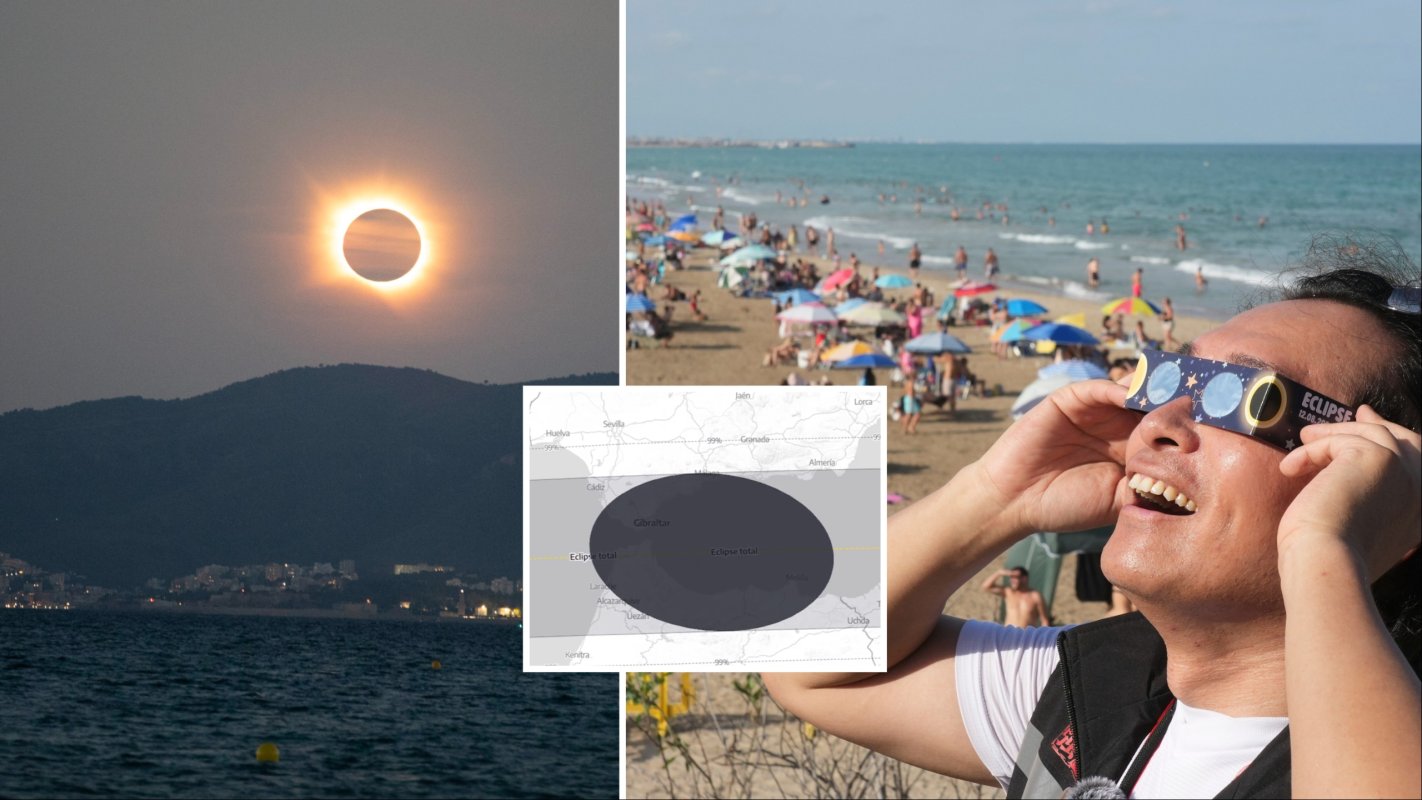
Multiple Southern Provinces Included in the Path of Totality
To capture the breathtaking moment when the sun completely disappears and the solar corona emerges, observers must be within the path of totality. Official data indicates that the core observation areas in 2027 will be concentrated in southern Spain and its autonomous cities. Specifically, this includes the vast majority of the Cadiz province, the central areas of the Malaga province, the southernmost tips of Granada and Almeria provinces, as well as the cities of Ceuta and Melilla.
For other regions of Spain not located within the path of totality, residents can still enjoy a partial solar eclipse with a very high magnitude. The Spanish National Geographic Institute points out that the solar obscuration rate will exceed 70% nationwide.
Morning Observation Schedule
Unlike the dusk eclipse of 2026, the astronomical spectacle of 2027 will unfold in the morning. Based on peninsular Spain standard time, the partial phase of the eclipse is expected to begin around 9:30 AM and gradually move eastward.
The exact time and duration of totality will vary depending on the geographical location. For instance, totality in Cadiz will occur at 10:45 AM and last for about 2 minutes and 54 seconds; Malaga will experience totality at 10:48 AM, lasting approximately 1 minute and 48 seconds; Melilla will experience a period of darkness lasting up to 4 minutes and 34 seconds. Notably, Ceuta boasts the best observation conditions within Spanish territory, with its totality phase occurring between 10:45 AM and 10:50 AM, lasting an impressive 4 minutes and 48 seconds.
Future Astronomical Prospects
After this astronomical feast concludes, the Spanish public will also welcome an annular solar eclipse on January 26, 2028. At that time, because the moon’s apparent diameter will be insufficient to completely cover the solar disk, a dazzling “ring of fire” will appear in the sky. This path of annularity will sweep across parts of Andalusia, Murcia, the Valencian Community, the Community of Madrid, as well as Aragon and Catalonia.
However, to witness the spectacular phenomenon of daytime turning into night during a total solar eclipse in mainland Spain again after 2027, people will have to endure a long wait until 2053. This significant time gap further highlights the preciousness of the consecutive viewing opportunities in the next two years.
