The Ebb and Flow of Eastern European Immigration
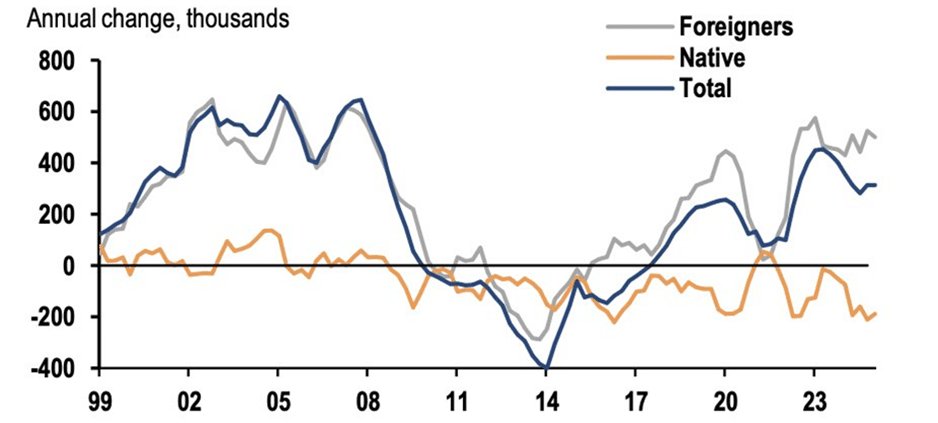
According to data from Spain’s National Statistics Institute (INE), the number of immigrants from certain Eastern European countries in Spain has seen a significant decline over the past decade. For instance, the Romanian immigrant population peaked at over 750,000 in 2012 but had dropped to 521,100 by January 2025, a decrease of 30%. The Bulgarian immigrant community has followed a very similar trajectory, with its numbers falling from 147,500 in 2009 to 101,500 in 2025, a 31% reduction. This sustained exodus indicates that for Eastern European workers with marketable skills, the traditional appeal of the Spanish market is steadily diminishing.
The Explosive Growth of Latin American and North African Immigration
As Eastern European labor gradually withdraws, immigrants from Latin America and North Africa are filling the market void on a massive scale. Statistical data shows that the number of Colombian immigrants in Spain was approximately 341,200 in 2008; by 2025, this group had nearly tripled to 978,000. The growth curve for Venezuelan immigrants is even steeper, soaring from 130,000 in 2008 to nearly 700,000 in 2025, an increase of about fivefold. Additionally, Moroccan immigrants increased from around 680,000 in 2008 to 1.16 million in 2025. In recent years, the home countries of these immigrants have often faced severe economic crises or social turmoil, making the pressure to survive a primary driver for seeking a new life abroad.
A Seismic Shift in Industry: The Cooling of Construction and Expansion of Services
This shift in immigration patterns is essentially a reflection of the transformation in Spain’s economic production model. During the economic expansion and real estate bubble of the early 21st century, there was strong demand for jobs in construction, industrial manufacturing, and related technical fields, which directly fueled the initial wave of Eastern European immigration. However, employment data from the National Statistics Institute shows that the number of jobs in the construction sector plummeted from 2.57 million in 2008 to 1.77 million in 2026, a loss of about 800,000 positions (a 31% decrease). During the same period, the industrial sector shed 256,000 jobs, with manufacturing employment falling from 2.74 million to 2.39 million. The allure of professions like electricians, plumbers, and bricklayers, which once heavily relied on Eastern European immigrants, has faded.
In stark contrast to the decline in physical industry and construction, the service sector has experienced unprecedented expansion. Currently, the total number of people employed in Spain’s service sector is 2.56 million higher than in 2008, a 17% increase. Among the four major economic sectors, the service industry’s share of employment has grown from 70% to 77%, while the weight of the construction industry has dropped below 8%.
Driven by a Dual Force: Macroeconomics and Supply-Demand Matching
When Romania and other countries joined the EU in 2007, Spain chose to waive the two-year transitional period for labor market access, thereby absorbing a large number of much-needed Eastern European workers. Today, however, the macroeconomic environment has reversed. On one hand, domestic inflation and soaring housing prices in Spain have drastically increased the cost of living, squeezing the financial viability of low-income immigrant families. On the other hand, nearly two decades of EU integration have led to significant economic recovery in Eastern European countries, prompting a return flow of their citizens.
In contrast, the new wave of Latin American immigrants is not arriving in a Spain defined by heavy construction, but in an economy dominated by hospitality, restaurants, elderly care, retail, and administrative services. Leveraging their native Spanish language skills, existing compatriot networks, and the relatively low entry barriers to these industries, Latin American immigrants can quickly integrate into this service-centered economic network. This has ultimately led to a major reshuffling of the labor market.
