Introduction
The vacation systems across the European continent are diverse and complex, with non-working days composed of four main elements: religious festivals, national public holidays, company-provided paid annual leave, and regular weekends. A deep understanding of this structure, especially the variations between countries and regions, is crucial for international business dealings.
The Foundation of Holidays: Religious Festivals and Two Calendar Systems
Christian tradition forms the bedrock of European public holidays, but two different calendar systems within it directly affect the scheduling of these days.
Catholic/Protestant System (Gregorian Calendar): This calendar is used by the vast majority of Western, Central, and Southern European countries, including France, Germany, Italy, and Spain. Common religious holidays include New Year’s Day (January 1), Easter-related holidays (dates vary), the Assumption of Mary (August 15), All Saints’ Day (November 1), and Christmas (December 25-26). Some countries with strong Catholic traditions, like Spain, also celebrate Epiphany (Three Kings’ Day, January 6).
Orthodox System (Julian/Revised Julian Calendar): This system primarily influences Southeastern European countries such as Greece, Romania, Bulgaria, and Cyprus. It’s noteworthy that while most Orthodox countries have adopted the Revised Julian calendar, setting Christmas on December 25, the calculation for Easter still follows the old Julian calendar, causing it to typically fall 1 to 5 weeks later than in the Western Church. A few countries, like Serbia, fully adhere to the old calendar, celebrating Christmas on January 7.
National Public Holidays: A Range from 9 to 17 Days
In addition to religious festivals, countries also have their own national holidays, such as National Day or Liberation Day. When combined, the total number of public holidays varies significantly from country to country. Here is some data for selected European nations (excluding holidays that only fall on a Sunday):
- 15 days: Cyprus
- 14 days: Spain, Bulgaria, Croatia, Malta, etc.
- 11 days: France, Greece, Sweden, etc.
- 9 days: Germany (federal level), Netherlands, Denmark
Furthermore, regional differences exist within some countries. For example, Germany has 9 federal public holidays, but the heavily Catholic state of Bavaria has up to 13. Similarly, Spain’s 14 public holidays include those determined by its autonomous communities and regions.
The number of public holidays in Romania is dynamically increasing. According to its laws, public holidays have gradually risen from 15 days in 2011 to 17 days by 2025, placing it among the top in Europe.
Paid Annual Leave: The EU Directive and National Practices
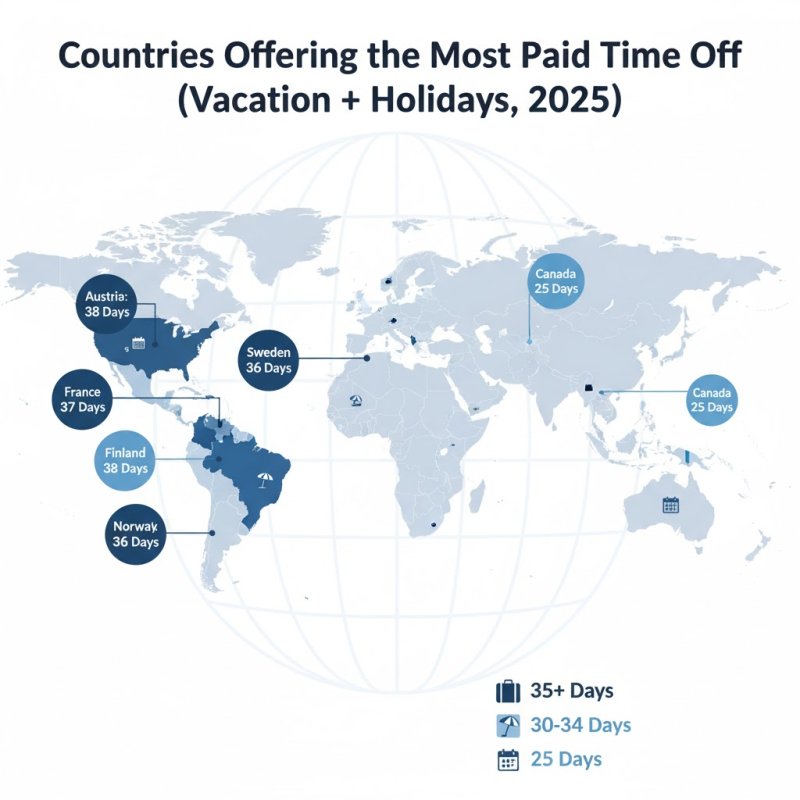
Paid annual leave is another vital component of the European vacation system. Under the EU’s Working Time Directive, all member states must guarantee employees at least 4 weeks (20 working days) of paid annual leave per year. This right, in principle, cannot be replaced by a cash payment (except upon termination of employment).
On top of this, many countries mandate a longer minimum annual leave:
- 20 working days: Germany, Belgium, Netherlands, Italy, Ireland, and most other countries.
- 22 working days: Spain, Portugal.
- 25 working days: France, Austria, Denmark, Sweden.
These are just the statutory minimums. According to Eurofound, the EU’s agency for the improvement of living and working conditions, collective bargaining agreements often result in employees receiving more vacation days. For instance, annual leave in German companies commonly ranges from 25 to 30 days.
Total Annual Non-Working Days and Business Implications
By adding up the public holidays, actual paid annual leave, and approximately 104 weekend days per year, the total number of non-working days for a European employee is quite substantial. Taking a typical employee in Spain as an example, the number of days off is roughly: 14 days (public holidays) + 22 days (minimum annual leave) + 104 days (weekends) = 140 days.
This vacation structure has a direct impact on business operations. It is advisable to avoid scheduling important business decisions, contract signings, or payments during peak holiday periods such as Easter, the long summer break in July and August, and the Christmas/New Year season starting from mid-December. Planning ahead and being aware of the holiday calendar in your target market is key to ensuring smooth business operations.
