Recently, the military balance between Spain and its southern neighbor, Morocco, has once again drawn the attention of regional observers. A comprehensive assessment shows that while Spain still holds a significant overall military advantage, Morocco is altering the local balance of power through targeted, modern acquisitions.
Budget and Overall Picture: A Formidable Gap
There is a vast disparity in defense spending between the two countries. According to data from the Stockholm International Peace Research Institute (SIPRI), Spain’s total defense and security expenditure for 2025 is projected to reach approximately $40.2 billion, whereas Morocco’s defense budget for the same period is about $6.3 billion. This more than six-fold difference in military spending directly impacts the size of their armed forces, maintenance costs, R&D investment, and equipment procurement capabilities. This disparity in scale forms the basis of Spain’s lead in joint command, intelligence systems, logistics, and domestic military-industrial capacity.
Air and Sea Superiority: Spain’s Core Pillars
Spain’s air and naval forces are key to maintaining its regional superiority. The Spanish Air and Space Force (Ejército del Aire y del Espacio) is centered around the Eurofighter Typhoon and EF-18 fighters, supported by A330 MRTT multi-role tanker transports, A400M strategic transport aircraft, and an operational framework fully integrated into the NATO command and surveillance network. Furthermore, a plan to procure a new batch of Typhoon fighters is underway. In the naval domain, Spain operates F-100 series frigates equipped with the Aegis Combat System, the amphibious assault ship Juan Carlos I, and the new S-80 class submarines, providing it with powerful blue-water combat and power projection capabilities.
In contrast, the Royal Moroccan Air Force is smaller but its modernization efforts are notable. The United States has approved the sale of F-16 Block 72 fighters and plans to upgrade some of its existing F-16s to the F-16V standard. However, it must be noted that the approval of an arms sale does not mean all equipment has been delivered and achieved full operational capability. In the naval sphere, Morocco currently lacks submarines and large surface combatants comparable to Spain’s, which limits its control over vast maritime areas.
Land Forces and New Domains: Morocco’s Focus for Catch-Up
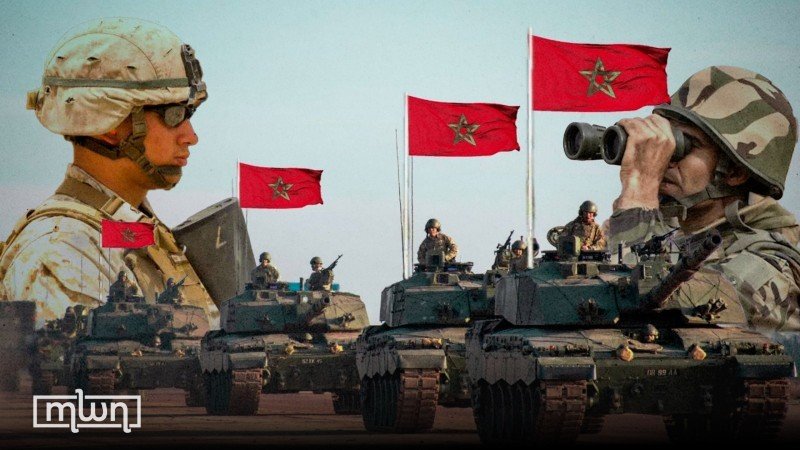
Morocco’s military catch-up is concentrated on its army and emerging domains like unmanned aerial vehicles (UAVs). The country has equipped itself with a large number of M1A1 Abrams main battle tanks and continues to acquire long-range artillery, air defense systems, AH-64E Apache attack helicopters, and various armed drones. Notably, the Moroccan army’s long-term involvement in low-intensity conflict in the Western Sahara region has provided its ground troops and drone units with a degree of combat experience.
The Spanish Army is built around the Leopard 2E main battle tank, the Pizarro infantry fighting vehicle, and the new 8×8 ‘Dragón’ wheeled armored vehicle, and is equipped with advanced air defense systems like the Patriot and NASAMS. In response to the new threat posed by drones, Spain is also actively strengthening its anti-drone technologies and long-range precision strike capabilities. Analysts point out that a simple comparison of the number of tanks, artillery, or drones does not fully reflect combat power; factors like equipment readiness rates, ammunition stockpiles, maintenance capabilities, and personnel training levels are equally decisive.
Systemic Confrontation: The Pros and Cons of NATO vs. Diversified Procurement
From a strategic perspective, Spain, as a full member of NATO, can deeply leverage the alliance’s intelligence, surveillance, logistics, and potential reinforcement systems, which act as a significant force multiplier in a potential conflict. Additionally, Spain possesses a relatively complete defense industrial base, capable of autonomously producing and maintaining key assets like frigates, submarines, and armored vehicles.
Morocco, on the other hand, has adopted a diversified arms procurement strategy, with its advanced equipment sourced from multiple countries including the United States, France, Israel, Turkey, and China. While this strategy allows for rapid acquisition of cutting-edge technology, it also presents challenges such as a complex equipment ecosystem, and non-uniform logistics, maintenance, and training standards.
In conclusion, in the event of a short-term, small-scale local crisis, Morocco could leverage its geographical proximity, ground force advantage, and rapidly concentrated elite units to exert significant pressure on Spain. However, if the conflict escalates into a prolonged, high-intensity, full-scale confrontation, Spain’s advantages in naval and air power, industrial base, financial resources, and the NATO alliance system would become more pronounced and would be the key factors in determining the war’s outcome.
