Medieval Defenses and Early Municipal Detention Systems
In the history of Valencia’s urban expansion, the survival of its ancient city walls is closely linked to their function as prisons. The Torres de Serranos, an iconic Valencian monument, was urgently converted into a prison for nobles and knights after a fire at the city hall prison in 1586. During the Spanish Civil War, its lower level was even reinforced to serve as a bunker protecting national treasures from Madrid’s Prado Museum. The other ancient city gate, the Torres de Quart, was used as a common prison and housed the ‘Casa Galera’ women’s penitentiary between 1651 and 1808. When the medieval walls were demolished in the mid-19th century, these two towers were spared precisely because they were still functioning as prisons.
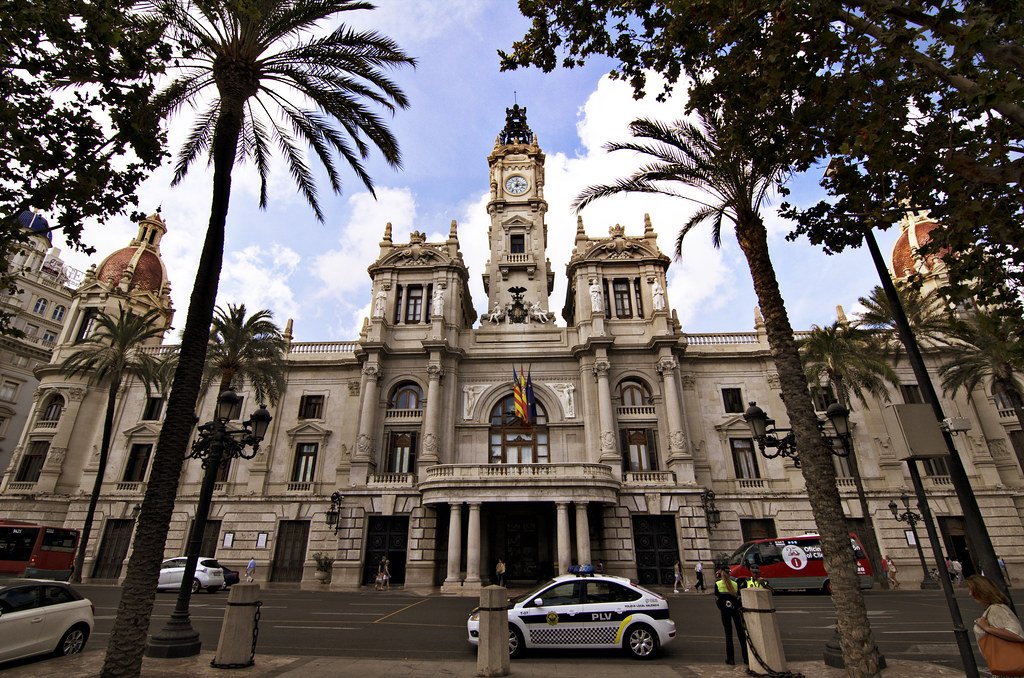
In the early municipal system, administrative and punitive functions were often housed in the same building. The ground floor of the old City Hall (Casa de la Ciudad), next to the current Palau de la Generalitat, once contained a temporary holding facility. Meanwhile, the San Narcís Prison, which served as the city’s main penitentiary for over 300 years, was plagued by frequent escapes due to structural flaws and was finally decommissioned and demolished in 1873.
Modern Penological Experiments and Spatial Transformation
As modern penal concepts evolved, Valencia constructed several large-scale prisons, all of which have now been completely transformed. The Valencia Model Prison (Cárcel Modelo), completed in 1903, initially featured an innovative panopticon design intended to hold 500 inmates for humane rehabilitation. However, in the post-war period, it became severely overcrowded, holding nearly 15,000 prisoners. The prison was decommissioned in 1991 and is now the '9 d’Octubre’ Administrative Complex of the regional government.
The Pechina Provincial Women’s Prison, built between 1922 and 1925, also saw its destiny reshaped. Today, it has become the '9 d’Octubre’ public school. In 1959, the last woman to be executed by garrote in Spain, Pilar Prades, was held here; a lone plaque on the school’s exterior wall now commemorates this somber history. Furthermore, the building that now houses the popular Fallero Museum (Museo Fallero), originally built in 1826, once served as the strict Monteolivete Military Prison (Prisión Militar de Monteolivete).
Echoes of History in Religious Sites and Commercial Sanctions
Many religious buildings were also entangled in the historical penal system. The Monastery of San Miguel de los Reyes, now home to the Valencian Library and the Valencian Language Academy, was used as a prison for political dissidents during the early Franco regime in 1939, with many death row inmates taken from here to be executed by firing squad in Paterna. Similarly, the current headquarters of the Valencian Anti-Fraud Agency on Calle Navellos was, for centuries, the site of the fearsome Palace of the Inquisition (Palacio de la Inquisición), where heretics were tried, until its demolition in 1920. The Presidio de San Gregorio once held political prisoners, including the renowned author Vicente Blasco Ibáñez.
In the commercial sphere, the Lonja de la Seda (Silk Exchange), a UNESCO World Heritage site, also concealed a punitive function. Its Gothic tower housed a small cell on the ground floor specifically for imprisoning defaulting merchants who failed to pay debts or forged bills. From sacred crypts (like the Crypt of San Vicente Mártir) to secular commercial law, these former cages hidden within the stonework collectively form Valencia’s diverse and complex urban memory.
