The Hidden Dangers Behind Convenience
On hot summer days, chilled watermelon is a popular treat to beat the heat. For convenience, many shoppers opt for watermelons already cut in half or into smaller pieces at the supermarket. However, experts in nutrition and food safety widely point out that this convenient choice conceals significant food safety risks.
A whole watermelon has a tough rind that acts as a natural barrier, effectively protecting it from external microorganisms. Once cut, the flesh is directly exposed to the air, and its sugar- and water-rich environment becomes a breeding ground for bacteria. From the moment it is cut, the conditions for keeping it fresh become extremely strict, relying on continuous refrigeration.
Clear Regulation: No More Than Three Hours at Room Temperature
The Spanish government has established clear regulations for the sale of pre-cut fruits and vegetables. According to Royal Decree 1021/2022, published in Spain’s Official State Gazette (Boletín Oficial del Estado), it is explicitly required that fruits or vegetables cut at the point of sale must not be displayed at room temperature for more than 3 hours. After this period, they must be moved to refrigerated conditions (typically below 5°C) for storage and display.
Despite this rule, it is difficult for the average consumer to verify whether a supermarket has strictly adhered to this time limit. Information about how long a piece of cut watermelon has been on the shelf or if it has experienced temperature fluctuations is often unknown.
Risks of Cross-Contamination and “Invisible Spoilage”
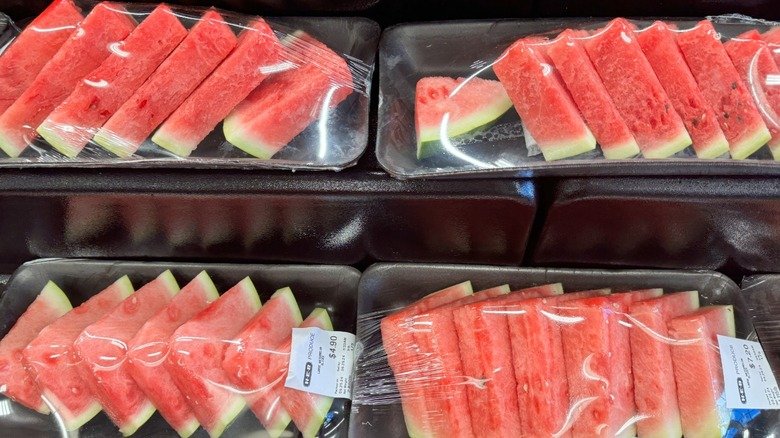
In a supermarket environment, another major risk for cut watermelon is cross-contamination. During the selection process, other customers might touch or press the flesh to gauge its freshness, actions that can transfer bacteria from their hands to the watermelon.
More alarmingly, fruit in the early stages of microbial contamination may show no obvious changes in appearance, smell, or even taste. This “invisible spoilage” can lead consumers to unknowingly ingest food that is no longer fresh or is contaminated. Food safety experts emphasize that the core issue isn’t that cut watermelon is inherently toxic, but that the entire chain from cutting to sale involves too many uncontrollable risk factors.
Expert Advice: Choose Whole Fruits for Safety
Considering all the risks mentioned, the primary recommendation from multiple food safety experts is unanimous: whenever possible, always prioritize buying a whole watermelon and preparing it yourself at home in a clean environment. While this requires a bit more time and effort, it is the most reliable way to ensure your family’s food safety. Handling it yourself not only guarantees the hygiene of your knives and cutting boards but also allows for immediate consumption or proper refrigeration, minimizing the risk of bacterial growth.
