Introduction
On September 7, 2026, Princess Leonor, the heir to the Spanish throne, officially began her university life at the Getafe campus of Universidad Carlos III de Madrid. Her ‘commoner’ outfit—a pair of €27 Stradivarius jeans, a white shirt, and sneakers—sparked widespread discussion in Spanish society. However, behind this deliberate attempt at discretion lies the stark collision between her inescapable royal aura and the real world.
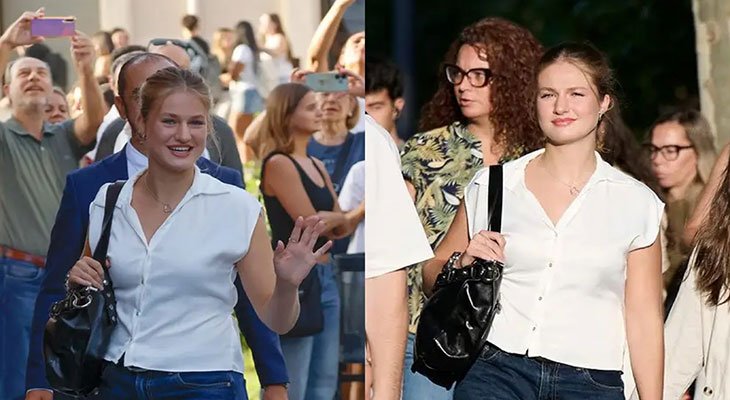
The Contrast Between a ‘Low-Key’ Arrival and a Grand Welcome
On her first day, Princess Leonor arrived on campus in casual attire, with her hair in a simple braid and carrying a large black backpack, aiming to blend in with the student body. However, the scene both on and off campus was starkly different. Over 50 media outlets, with reporters and photographers, were already waiting at the university gates. Meanwhile, she was personally greeted at the entrance by the university’s Rector, Ángel Arias; Vice-Rector, Pilar Otero; and the Dean of the Faculty of Social and Legal Sciences, Antonio Descalzo. This sharp contrast between her simple outfit and the grand reception became the first major point of public discussion.
The Inevitable ‘Royal Effect’
Although both the Royal Family and the university stressed that Leonor would attend as a regular student without special academic privileges, the ‘royal effect’ was evident even before she set foot on campus. The university entrance score for her major rose from 9.542 to 10.728 this year. Commercial activities also quickly capitalized on her arrival. The design platform Canva set up an advertisement at a nearby bus stop featuring a velvet ‘throne’ and a golden crown, with the slogan, ‘Welcome to university, Princess. Here, everyone has a crown,’ which quickly became a popular photo spot on social media. The university cafeteria also seized the opportunity, offering a so-called ‘menu with royal charm,’ even though the Princess herself had left the campus by just after 2 PM and did not dine there. These phenomena have created a massive bubble of attention around her, making ‘ordinary’ an unattainable luxury.
The Paradox of ‘Going Common’ and the Reference to Her Mother
Princess Leonor’s choice of a public university and affordable clothing is seen by many as part of the Royal Family’s effort to cultivate an accessible image. However, from the plainclothes security guards who are always nearby to her elite upbringing—from her birth at the Ruber International Clinic, her education at Santa María de los Rosales School and UWC Atlantic College, to her military training—her life is far from ‘common.’ Her mother, Queen Letizia, offers a true example of a commoner’s journey. Coming from an ordinary family, Letizia became a renowned top news anchor for Spanish national television through her own hard work, even reporting from war zones like Iraq, and had a highly successful career before marrying into the Royal Family. Compared to the ‘ordinary life’ experience her mother earned through personal struggle, Leonor’s challenge is to truly understand the lives and thoughts of ordinary people from within her inherently special status.
A ‘Required Course’ for the Future Queen
Princess Leonor’s university life is less about playing a ‘commoner role’ and more of a required course for a future head of state to deeply understand the fabric of Spanish society. In a divided era, the public expects their future monarch to understand their real struggles, such as academic pressure, job prospects, and mortgage burdens. For someone destined for an extraordinary life from birth, breaking out of her information bubble and invisible barriers to experience and comprehend ‘the ordinary’ may be the most important and difficult subject she faces during her four years at university, beyond her academic studies. Her proactive step to join a classroom of regular students is, in itself, a commendable effort.
