Record-Breaking Downpour Paralyzes the City
Around 4:00 PM on September 9, 2026, a rare and extreme localized convective storm swept through the Region of Murcia, Spain. According to monitoring data from local meteorological and emergency services, many areas in the region recorded 44 liters per square meter of rainfall in just over 30 minutes, with the peak in the Reguerón area soaring to 67 liters. Faced with the sudden deluge, the 112 emergency center received over 238 urgent calls in a very short period.
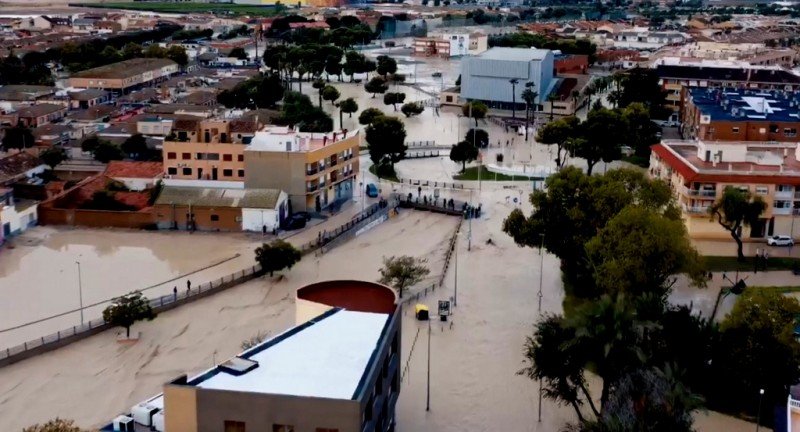
The downpour instantly overwhelmed the city’s drainage capacity, quickly turning major roads in downtown Murcia and surrounding towns like El Palmar and La Alberca into raging rivers. The intense water pressure even blew off heavy manhole covers in several places. Some vehicles stalled in the floodwaters, forcing their owners to push them to safety through the water.
Infrastructure Damage and Traffic Network Disruption
The violent storm caused significant damage to Murcia’s urban infrastructure. The San Antón neighborhood experienced widespread power outages, and numerous street-level shops and underground garages were flooded. On Avenida Primo de Rivera, strong winds uprooted a large tree.
More alarmingly, a large decorative arch built for the festival on the ‘Puente de los Peligros’ (Bridge of Dangers) collapsed amidst the wind and rain, prompting local police to completely close the bridge. The traffic system was also thrown into chaos, with traffic lights at the core intersection of Gran Vía malfunctioning for several minutes. Police implemented emergency traffic control on several severely flooded ramblas (dry riverbeds) and roundabouts.
Traditional ‘September Fair’ Comes to a Complete Halt
Given the severe situation and potential safety risks, the Murcia City Council acted swiftly, ordering a complete halt to all major outdoor celebrations for the ‘Feria de Murcia’ (September Fair) that day. This included the emergency closure of the traditional Los Huertos food stalls, the food truck market, the Ferris wheel, beer gardens, and the FICA fairground.
Furthermore, several tent structures in the Moors and Christians encampments were severely damaged by the strong winds. All related outdoor performances were also canceled to ensure the safety of residents and tourists.
Coastal Towns Affected and Drainage System Controversy
The extreme weather event not only devastated downtown Murcia but also affected several coastal municipalities, including Cartagena, Torre Pacheco, San Javier, and the Mar Menor village of Los Urrutias.
In the aftermath of the disaster, the city’s flood resistance and drainage capacity became a public focus. Many local residents pointed out on social media that numerous storm drains in the city are perennially clogged with leaves, debris, and silt. They argue this blockage prevented rainwater from draining properly and was a significant man-made factor in exacerbating the flood.
Meteorological departments have issued further warnings, indicating that conditions for convective rainfall will persist in the region over the next few days. Officials are urging the public to avoid low-lying flooded areas and rambla crossings when traveling to ensure driving safety.
