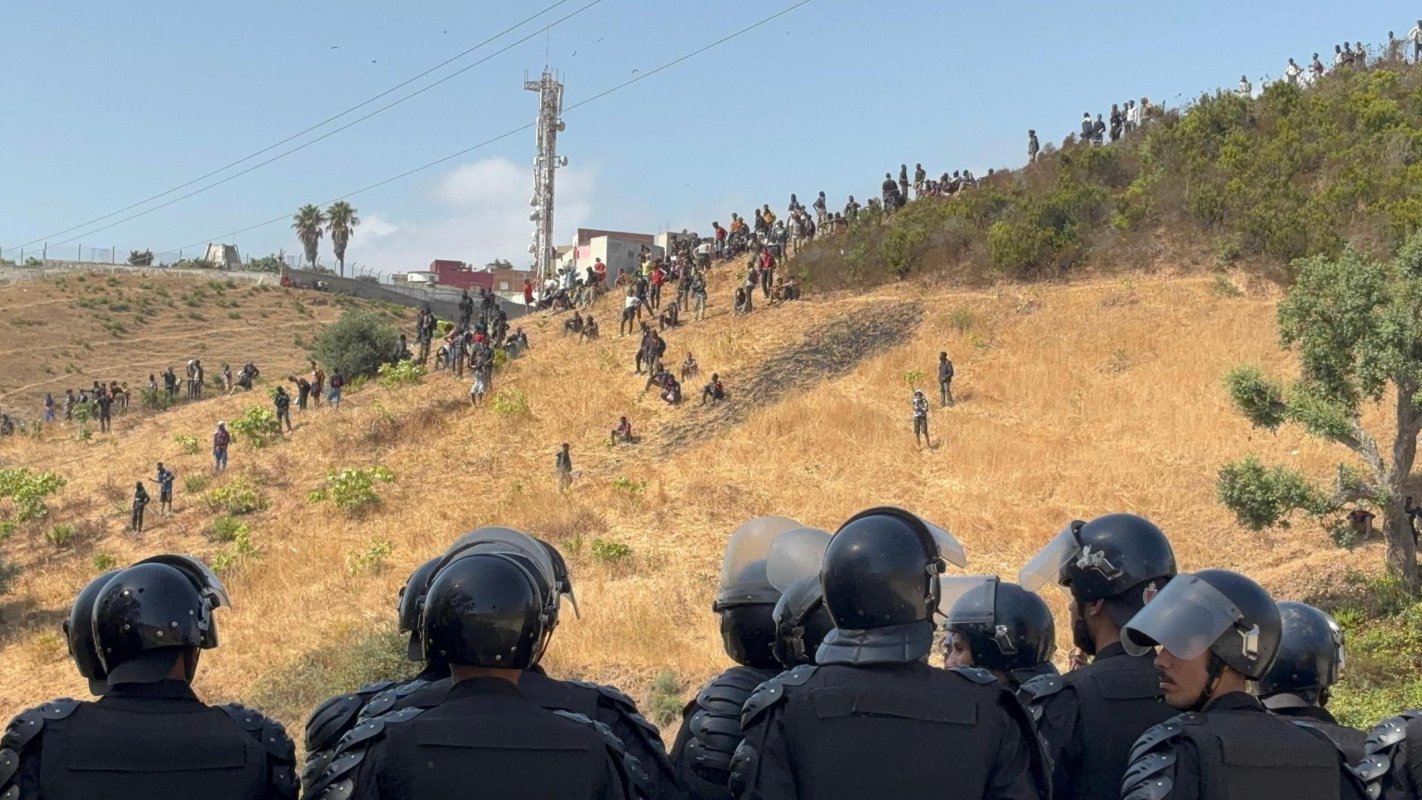
Recently, Trampolin Beach in Ceuta, Spain, has been facing a severe migrant crisis. Since the massive border crossing incidents in July this year, thousands of undocumented migrants, primarily from the North African Maghreb region, have set up camp here, forming a massive settlement stretching approximately one kilometer. As the camp continues to expand, the local area is experiencing unprecedented pressure regarding public security, public health, and refugee resettlement.
Coastal “Floating City” and Underground Trade
The current migrant camp on Ceuta’s Trampolin Beach has begun to resemble a small community. On-site observations reveal that the camp not only features shower facilities and portable toilets but also open-air barber stalls and a makeshift mosque. Simultaneously, a spontaneous market is in operation, with vendors selling various daily necessities including food, beverages, chargers, furniture, and second-hand clothing. Some goods are purchased from the local Mercadona supermarket and resold at a markup, while others are salvaged by migrants from local recycling centers.
Beyond basic supplies, security risks in the area are becoming increasingly prominent. Multiple sources confirm that the trade of alcohol and contraband has quietly emerged within the camp, with some vendors secretly selling marijuana. Interviewees disclosed that most of these drugs flow into the camp from the nearby Principe or Hadu neighborhoods, further complicating management efforts.
Healthcare System Under Pressure and Red Cross Intervention
With the sudden surge in crowd size, the local healthcare and humanitarian relief systems are operating at overcapacity. Every afternoon, the Spanish Red Cross, escorted by the National Police, distributes basic food supplies to the camp. Three ambulances are parked at the edge of the camp, converted into temporary medical aid stations.
A medical team composed of doctors, nuns, and volunteers must provide consultations for approximately 200 stranded individuals daily. The most common health issues currently seen in the camp include scabies, fungal infections, colds, and various open wounds. For patients with critical symptoms, the medical team has no choice but to rush them to the emergency room, directly exacerbating the operational burden on Ceuta’s local medical network.
Social Media Driven Movement and Registration Deadlock
Currently, a large number of migrants are still waiting for official identification registration and spots in temporary shelters, but cumbersome administrative procedures have caused sluggish progress. The Spanish government’s stance on undocumented immigrants is shifting, moving from an initial promise of comprehensive deportation to gradually transferring some individuals to temporary shelters.
In this process, social media platforms (such as Instagram, TikTok, and WhatsApp) have played a double-edged role. These platforms, which previously served as communication tools for organizing massive border crossings, are now being used by some migrants to tip each other off. Many are using the internet to urge their peers to refuse entry into the camps or decline official registration in order to evade potential risks of detention and deportation.
Political Calls for Mainland Relocation Spark Controversy
In response to the current stranding dilemma in Ceuta, different voices have emerged within Spanish political circles, sparking widespread discussion. Irene Montero, former senior leader of the Podemos party and former cabinet minister, has publicly called for governments at all levels to share the responsibility and relocate the estimated 7,000 to 10,000 migrants stranded in Ceuta to the Spanish mainland.
Montero emphasized that Spain previously successfully absorbed about 350,000 Ukrainian refugees and 200,000 Venezuelan immigrants, proving it has the necessary resettlement capacity. She linked the outcry against receiving North African migrants to racism against Moroccans, urging the authorities to implement proper accommodation and material support mechanisms as soon as possible.
