Core Data: Resale Homes Lead the Surge, Overall Housing Prices Break Historical Highs
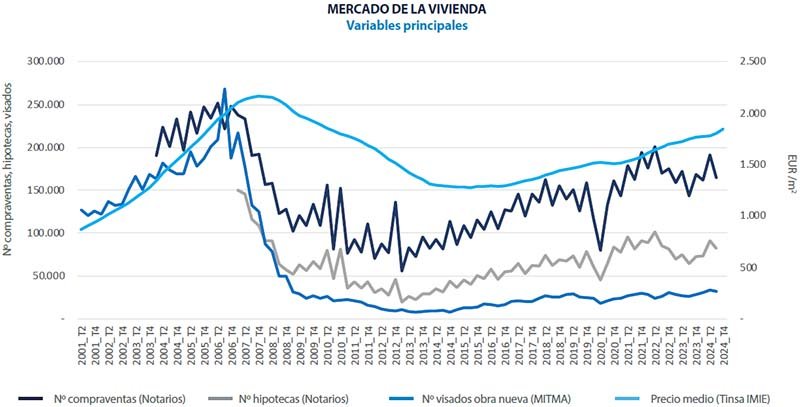
According to Q2 2026 data released by the Spanish National Statistics Institute (INE), the national average housing price climbed 12.2% year-on-year. During this upward cycle, the resale housing market absorbed massive spillover demand due to a severe shortage of new housing supply, surging 12.9% year-on-year and becoming the core engine driving the broader market. The new housing market, constrained by prolonged development cycles caused by a shortage of local construction workers, saw a 7.4% year-on-year increase.
Macroeconomically, the cumulative growth of Spanish housing prices over the past three years has reached a staggering 36.3%. Currently, the overall housing price index is 31.7% higher than the historical peak during the 2007 real estate bubble. Even after adjusting for inflation, the actual asset value remains at an absolute high.
Foreign Capital Influx: One in Six Transactions Made by Foreign Buyers
Data from the Spanish Association of Property Registrars indicates that the market share of foreign buyers reached a record high of 15.98% in Q2 2026. Within a single quarter, foreigners completed over 26,800 transactions, meaning that one out of every 6.25 homes sold was purchased by a non-national.
Regionally, foreign interest is highly concentrated in coastal and resort areas. The Balearic Islands topped the list with a 32.2% foreign buyer share, followed closely by the Valencia region (31.03%) and the Canary Islands (29.33%). In terms of buyer origin, the UK (6.99%), the Netherlands (6.94%), and Germany (6.11%) ranked in the top three. Overall, more than 57% of foreign buyers come from EU countries, leveraging the EU’s free movement policies to make Spain their preferred relocation destination.
Regional Disparities: Hot Resort Areas Outpace the Capital’s Core in Premium Pricing
In Q2 2026, all autonomous communities in Spain recorded positive year-on-year housing price growth, but the trend of regional polarization has become increasingly apparent. Areas with originally lower price bases, such as Ceuta (+15.2%), Asturias (+15%), and Castile and Leon (+14.8%), experienced strong compensatory surges. Meanwhile, Navarre, the Basque Country, and Catalonia, despite having the lowest growth rates, still achieved levels between 9.5% and 10.1%, far exceeding the Eurozone average.
In terms of absolute average prices, Madrid firmly held the national top spot at 4,477 euros per square meter. The Balearic Islands ranked second with an average price of 4,311 euros per square meter, while its capital, Palma, saw average property prices soar to 4,291 euros per square meter. This reflects that the premium pricing power of top-tier coastal resort properties is now fundamentally on par with the capital’s core urban areas.
Market Trends and Property Buying Tips: Price-Volume Divergence and Invisible Residency Barriers
In the first half of 2026, total residential sales in Spain fell slightly by 2.6% to approximately 347,000 units, yet the volume of newly signed housing mortgages bucked the trend with a 7% increase (reaching 259,684 transactions). This phenomenon of “rising prices with a slight dip in volume” alongside increased financing indicates that rigid demand and investment capital are still continuously entering the market using financial leverage. Against the unchanged fundamental backdrop of robust demand and insufficient supply, the market is highly likely to maintain its upward trajectory in the future.
For prospective buyers, the current market environment imposes higher requirements. Besides needing to reserve a sufficient budget to cope with rapidly rising costs and locking in bank loan quotas in advance, buyers must also be wary of purchasing restrictions in certain areas. In regions like Valencia and the Canary Islands, where the foreign buyer share exceeds 25%, some developers have implemented invisible “housing protection mechanisms” favoring local residents for housing supply. Purely overseas buyers lacking legal residency in Spain are often left to choose from residual inventory, placing them at a distinct disadvantage in terms of selection priority and bargaining power.
