Migrant Regularization Boosts Social Security Enrollment Rates
According to the latest macroeconomic forecast jointly released by the Foundation of Applied Economics Studies (Fedea) and BBVA Research, the number of social security enrollments in Spain is expected to record a quarter-on-quarter growth of approximately 1% in the third quarter of 2026, slightly up by 0.1 percentage points from the second quarter, equating to an annualized growth rate of about 4%. Behind this significant increase, the recently launched large-scale regularization of foreign immigrants (commonly known as “amnesty”) has played a decisive boosting role.
Rafael Doménech, a renowned economist at BBVA Research, points out that excluding the policy dividends of this immigration legalization process, the natural growth rate of Spain’s social security enrollments would only be between 0.5% and 0.6%. This indicates that the regularization policy has nearly doubled the net new employment scale for the current period, which is directly reflected in official statistics.
Foreign Workforce Becomes the Core Engine of Growth
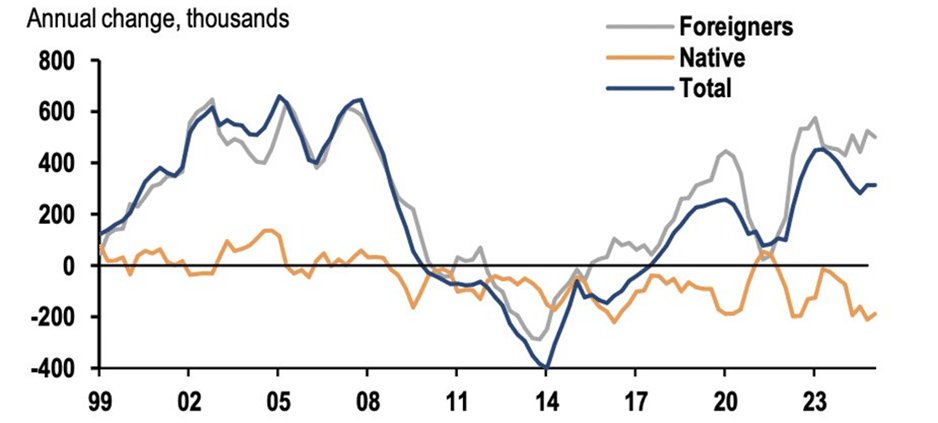
Macroeconomic data shows that the steady expansion of the Spanish labor market in recent years has been heavily dependent on the influx and employment conversion of foreign workers. Compared to pre-pandemic figures at the end of 2019, the employed foreign population in Spain has achieved a staggering jump of 59.6% by 2026. In stark contrast, the employment growth of native Spanish citizens during the same period was only 5.1%.
This trend highlights the dominant role of migrant workers in filling local labor shortages. The ongoing legalization procedures further integrate immigrants who might otherwise operate in the underground economy into the formal national statistics and social security system, thoroughly solidifying this structural shift in the workforce.
Concerns Over Domestic Employment and Labor Productivity
Despite the impressive overall employment figures, underlying challenges remain within the native Spanish labor market and productivity levels. The report reveals that native workers in certain age groups have not yet fully recovered from past economic shocks. Taking the statistics from June 2026 as an example, the employment numbers of native Spaniards aged between 35 and 44 still fail to reach normal pre-pandemic levels.
Furthermore, the increase in total national working hours in the second quarter of this year outpaced the growth rate of the Gross Domestic Product (GDP). Since the fourth quarter of 2019, GDP per employed person has remained almost stagnant, with the cumulative growth in hourly labor productivity inching up by a mere 2.4%. This indicates that the employment boom driven by headcount expansion has not effectively translated into a substantial improvement in core productivity.
Discrepancies Between Actual Unemployment Rates and Official Data
Regarding unemployment indicators, as the national active labor force maintains an expansion rate of about 0.4% per quarter, Spain’s official overall unemployment rate slightly decreased by 0.1 percentage points after rigorous seasonal adjustments, settling at 10.1%. The reduction in long-term unemployment has also contributed to improving the overall employment environment.
However, the economic community maintains a more cautious stance on the true employment predicament. Rafael Doménech emphasizes that if a broader statistical standard is applied - incorporating potential unemployed groups not traditionally counted in official figures - Spain’s current actual “broad unemployment rate” would be as high as 17.5%. While the regularization of foreign workers has cosmetically improved social security data in the short term, the deep-rooted optimization of employment structures still has a long way to go.
