Foreign Workers Become the Core Driver of Employment Growth in Spain
Currently, Spain’s employment landscape is undergoing a profound transformation due to large-scale regularization of foreign personnel. Data forecasts from Fedea and BBVA Research show that by the third quarter of 2026, total employment in Spain is expected to achieve a quarter-on-quarter growth of approximately 1%, translating to an annualized growth rate of 4%. Rafael Doménech, Chief Economist at BBVA Research, emphasized that this strong momentum is primarily driven by the normalization process of foreign workers. Excluding this policy factor, actual employment growth in Spain during the same period would be halved.
Widening Recovery Gap Between Native and Foreign Workers
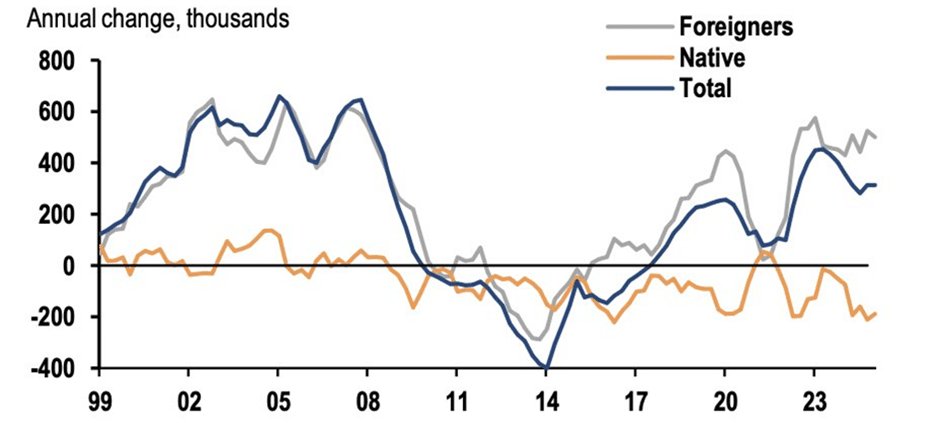
Statistical data reveal a polarizing trend among different groups in the labor market. From the end of 2019 to the present, the employment scale of foreign workers has experienced a massive expansion of 59.6%; in stark contrast, the employment growth for native Spanish workers is merely 5.1%. Further data indicates that as of June this year, the employment rate for native residents aged 35 to 44 has not even recovered to pre-pandemic levels. This discrepancy highlights the uneven performance of different groups during the economic recovery cycle.
Decline in Official Unemployment Rate alongside Hidden Unemployment Concerns
In terms of overall activity, Spain’s active workforce increased by about 0.4% quarter-on-quarter in the second quarter, and the reduction in long-term unemployed individuals directly drove the official unemployment rate down to 10.1%. However, underlying these impressive surface figures are hidden risks. Rafael Doménech points out that if a broader statistical measure is applied—including marginal groups not counted by traditional standards—Spain’s true potential unemployment rate could actually be as high as 17.5%.
Structural Contradictions Emerge: Employment Surges but Productivity Lags
The expansion of the labor force has not effectively translated into breakthroughs in productivity. Since the fourth quarter of 2019, despite a significant increase in new jobs, Spain’s per capita Gross Domestic Product (GDP) has essentially stagnated, with the cumulative growth in hourly labor productivity hovering around 2.4%. Fedea and BBVA Research warn in their assessment reports that relying on a surge of foreign workers to maintain a superficially prosperous job market exposes long-term structural shortcomings, such as low labor productivity. How to achieve a breakthrough in economic quality while expanding employment will be a core issue that the Spanish government urgently needs to address in the future.
