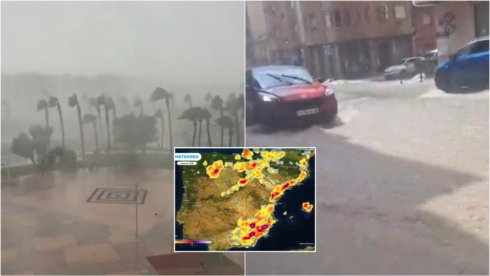
A recent deluge sweeping across eastern Spain has drawn public attention due to the stark contrast in weather alert levels between two neighboring regions. Thursday’s torrential rain put the province of Murcia on red alert, the highest level. In sharp contrast, despite severe flooding on the streets of some cities in the Valencian Community, authorities only issued an orange alert.
Alert Thresholds: Valencia’s Exceptionally High Standard
The root cause of this discrepancy in emergency alerts is not that Valencia has superior urban flood defense infrastructure, but that Spain’s National Meteorological Agency (Aemet) has set a much higher trigger threshold for the region compared to others. Under current standards, the rainfall required to trigger each alert level in Valencia is significantly elevated: a yellow alert requires 20 liters per square meter in one hour, and an orange alert requires 40 liters.
The disparity is even more pronounced for the highest-level red alert. Most regions in Spain issue a red alert when hourly rainfall reaches 60 liters per square meter, but the Valencian Community requires a staggering 90 liters. This means that under the same severe storm conditions, rainfall intensity in Valencia must be 50% higher than in neighboring areas to trigger an equivalent national disaster warning.
Outdated System: No Fundamental Changes in Nearly Two Decades
This controversial, regionally differentiated alert plan dates back to 2006. Over the past two decades, global climate patterns have changed significantly, with extreme rainfall events becoming more intense. At the same time, rapid urbanization has profoundly altered surface drainage capabilities. However, this outdated system of metrics has not evolved in step with urban development.
Even after the devastating storm of October 2024, which caused numerous fatalities and massive destruction, Spanish authorities failed to initiate a substantive revision of the storm alert trigger mechanism. Faced with increasingly frequent extreme weather, the excessively high thresholds mean that Valencia’s emergency red alerts are often delayed when facing life-threatening situations.
Misplaced Revisions: Ignoring Key Climate Characteristics
In fact, Aemet did undertake a major revision of the national weather alert system in 2022. However, to the public’s confusion, this overhaul focused primarily on adjusting snowfall indicators. For Valencia, a Mediterranean coastal region characterized by year-round aridity, winter snowfall is extremely rare. The greatest challenge to the region’s disaster prevention system is precisely the short, intense downpours that occur at the turn of summer and autumn. This policy revision, disconnected from the region’s actual climate characteristics, ultimately failed to address the critical issue of delayed storm alerts in Valencia.
