Free Public Transport in Valencia for a Day to Promote Green Mobility
In celebration of ‘World Car-Free Day’ on September 22, the city of Valencia and its metropolitan area offered free all-day public transport services. The initiative aimed to encourage citizens to reduce private car use in favor of more sustainable travel methods. The free service included Valencia’s Metro, trams, municipal buses (EMT), and metropolitan buses (MetroBús).
On the day of the event, metro station turnstiles were left open, allowing passengers to travel without validating a ticket. The municipal bus company, EMT, also placed 500 surprise 10-journey travel cards on its buses. While this was one of the closing events of European Mobility Week, studies indicate that a major challenge remains in improving the commuter system between Valencia and its surrounding towns to reduce reliance on private cars.
New Traffic Rule: Mandatory Seatbelts for Taxi Drivers
Starting October 1, Spain will implement new General Traffic Regulations, ending a long-standing exemption. Under the new rule, taxi drivers, freight vehicle operators, and driving instructors must wear a seatbelt when driving on urban roads. Violators will face the same penalties as regular drivers: a €200 fine and the deduction of 4 points from their driving license.
The regulation has sparked mixed reactions in the taxi industries of cities like Madrid and Barcelona. Some drivers argue that wearing a seatbelt is impractical due to the frequent getting in and out of the vehicle, with some even fearing it could become a hindrance during a potential nighttime assault. However, other drivers support the new rule, believing it will significantly improve road safety. The Metropolitan Taxi Institute of Barcelona has stated it will communicate the new regulation to over 14,000 local drivers and help them adapt.
Morocco Strengthens Security at Ceuta Border Ahead of Elections
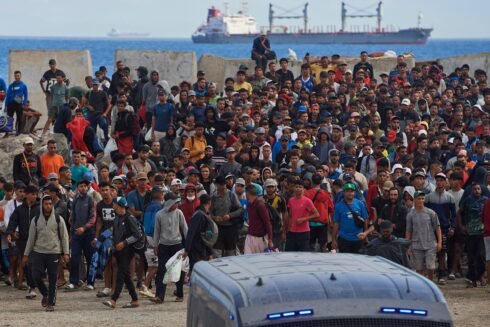
With parliamentary elections approaching on September 23, Moroccan authorities have significantly reinforced security along the border with the Spanish enclave of Ceuta. To prevent a recurrence of mass illegal entry incidents, thousands of security personnel have been deployed, equipped with water cannons and armored vehicles, while patrols along coastal and land routes have been intensified.
This comes after calls circulated on social media to organize a mass entry into Ceuta on election day, which the Spanish Embassy in Morocco has reported to Moroccan authorities. The Spanish government reiterated that illegally entering Ceuta or Melilla does not grant the right to travel to mainland Spain or move freely within the European Union. This heightened state of alert follows an incident at the end of July, approximately two months ago, in which over 70,000 people entered Ceuta.
Germany Plans to Tighten Protection Policies for Syrian Refugees
The German government plans to expand the scope of its review of protection status for Syrian refugees starting this autumn. Germany’s Interior Minister, Dobrindt, has instructed the Federal Office for Migration and Refugees (BAMF) to initiate revocation procedures for the protection status of more Syrian nationals. The reviews will initially target single, young, able-bodied men who are receiving social assistance.
The German government believes the situation in Syria has changed significantly since former Syrian President Bashar al-Assad was ousted in December 2024. Data shows that in the first half of 2026, out of 8,320 reviews completed by BAMF, 23.2% of protection statuses were revoked, a sharp increase from the 3.7% rate in 2025. Nevertheless, losing protection status does not mean immediate deportation, as individuals may still have the opportunity to obtain other legal residency permits through work or other means.
Soaring Energy Prices: Europe Faces a High-Cost Winter
Influenced by tensions in the Middle East, European natural gas and oil prices have recently surged, signaling a high-cost winter for the continent. European Commission officials have stated that the main risk is not an energy supply shortage, but the immense economic pressure that rising prices will put on households and businesses.
Currently, Europe’s natural gas storage levels are at approximately 69%, below the 85% level seen at the same time in previous years. Germany’s storage is at about 56%, while Spain’s is around 73%. The benchmark European natural gas price has surpassed €80 per megawatt-hour, reaching its highest level since late 2022. Simultaneously, Brent crude oil has exceeded $100 per barrel. Analysts worry that if high energy costs continue to ripple through other sectors, it could exacerbate the problem of inflation.
Spanish Youth Trapped in a ’Can’t Rent, Can’t Buy’ Housing Dilemma
Young people in Spain are facing a severe housing problem. A recent analysis shows that in the second quarter of 2026, the average monthly rent in Spain reached €1,204, while the average monthly mortgage payment for a newly purchased home was €825, making renting €379 more expensive than paying a mortgage. However, high down payment requirements make it difficult for young people to save for a home purchase while paying high rent, trapping them in an ‘impossible savings trap’.
This gap between renting and mortgage costs varies by region, with the largest difference of €484 found in the Valencian Community. As a result, the average age for young people in Spain to move out of their parental home has been delayed to 30.2 years, nearly four years later than the European Union average.
