Massive Number of Stranded Migrants and Severely Depleted Resettlement Resources
The crisis began in late July this year when false border policy information spread on social media, leading approximately 80,000 people to flood into the Spanish enclave of Ceuta from Morocco using extreme methods such as swimming. Although most subsequently left, data from the Spanish government and national security forces on September 18 indicates that about 10,000 undocumented migrants remain stranded. Juan Jesus Vivas, President of the Ceuta regional government, pointed out on September 11 that the actual number of stranded individuals could be as high as 13,000, including a large number of unaccompanied minors.
For Ceuta, which has a permanent population of only 84,000, this number has far exceeded its carrying capacity. Although the Spanish government urgently established a temporary shelter in the port area, its maximum capacity is only 1,700 people. Thousands of migrants are currently living on the streets, setting up makeshift tents in the mountains and on the beaches. As winter approaches, the living conditions for those stranded will face even more severe challenges.
Surging Crime Rates and Public Health Challenges
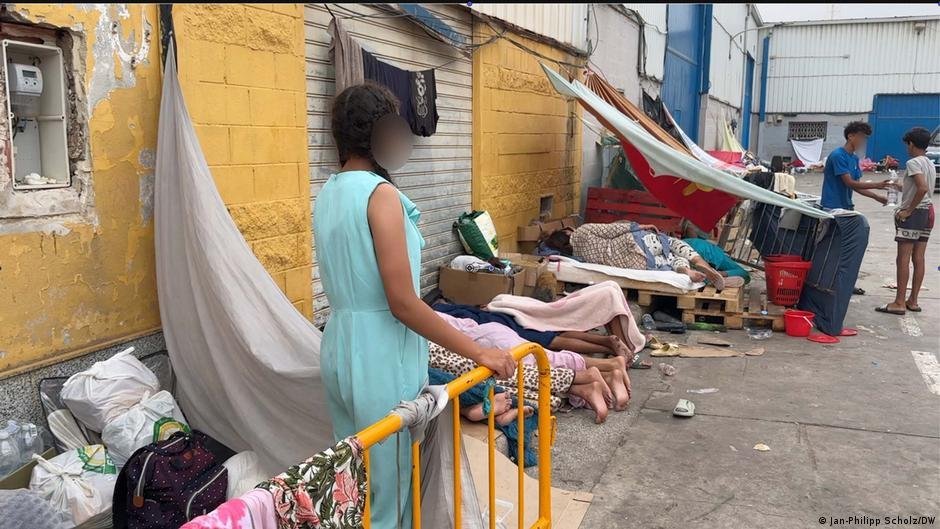
As the stranded period prolongs, Ceuta’s public security and health conditions have sharply deteriorated. Ceuta’s Chief Prosecutor, Silvia Rojas, warned that crimes such as sexual violence have shown an “exponential increase.” Data from the Spanish Ministry of Equality shows that 21 cases of sexual violence were reported locally in August alone, 9 of which involved underage victims. On September 3, a vicious security incident occurred in the old Regulares neighborhood of Ceuta, where a 25-year-old Moroccan man was fatally stabbed; a local woman involved in the case has been detained by the police.
In terms of public health, the dense population of people sleeping rough has increased the risk of infectious disease transmission. The health department has confirmed at least 5 cases of tuberculosis among the stranded individuals and found one Moroccan minor who tested positive for mpox. Such chaos has led to a surge in resentment among local residents, culminating in an extreme incident last month where residents stormed and burned a temporary migrant camp. Ceuta’s regional president, Vivas, described the city as a “pressure cooker that could explode at any moment.”
Intelligence Failures and Sluggish Central Government Response Spark Controversy
On the political response level, the Spanish central government’s crisis management capabilities have been questioned. It was not until late August that the Spanish cabinet first classified the Ceuta crisis as a matter of “national security interest” and established a unified command center. In a public speech on September 14, Spanish Prime Minister Pedro Sanchez admitted that authorities were facing immense pressure but denied any mishandling, promising to strive to bring the situation under control by the end of the year.
However, intelligence communication within the government has exposed obvious loopholes. Although the government delegation in Ceuta previously claimed to have no knowledge of the July 30 border crossing wave, 40 recently declassified communication records show that the Spanish National Intelligence Centre (CNI) had issued a warning as early as July 29, pointing out that large-scale border crossing operations via land and sea were being organized on social networks. This information gap has intensified external criticism of the border management mechanism.
Strong EU Intervention and Spain-Morocco Diplomatic Friction
The Ceuta crisis has gone beyond the bilateral scope and become a focal point for the European Parliament. On September 16, the European Parliament passed a related amendment with an overwhelming result of 435 votes in favor, 209 against, and 13 abstentions. The bill unprecedentedly used harsh words such as “attack” and “invasion,” demanding an independent and comprehensive investigation into the incident. Magnus Brunner, the designated EU Commissioner for Internal Affairs and Migration, reiterated that the swift repatriation of undocumented migrants is currently the core task of the EU.
Meanwhile, diplomatic relations between Spain and Morocco are once again facing a test. The regional government of Ceuta publicly accused Morocco of using the migrant wave to exert political pressure on Spain’s territorial integrity. Although the Moroccan Ministry of Foreign Affairs issued an official statement on September 10, firmly denying any participation or condoning of the human smuggling wave, an internal police report exposed by Spanish media earlier this month revealed that Moroccan police significantly reduced border patrols during the crisis, adopting an attitude of “complete tolerance” towards illegal border crossings. This contradiction makes the ultimate resolution of the crisis even more complicated.
