The Madrid Metro transit management authority announced that Line 6, which carries over 400,000 daily passengers, will implement partial weekend closures on several weekends from late September through the end of the year. This measure aims to facilitate closed system testing for the upcoming introduction of driverless trains. Passengers are advised to closely monitor official announcements to adjust their weekend travel plans.
Initial Closure Areas and Schedules
According to the preliminary plan published by the Madrid Metro company, the first closure segment is set between Cuatro Caminos and Lucero stations (passing through Moncloa). Specific closure dates are the consecutive weekends of September 26-27 and October 3-4. During these periods, Cuatro Caminos and Lucero will serve as temporary terminals where trains will turn around, while the intermediate section will be completely closed to accommodate testing. The metro company emphasized that this is only the first phase of a series of tests before the end of the year, with similar interruptions planned for other sections on subsequent weekends.
Transport Connections and Detour Advice
To minimize the impact of the works on public mobility, Madrid Metro will introduce a free special shuttle bus service at street level covering the affected route. Concurrently, the management authority recommends that passengers take full advantage of Line 6’s circular network to detour using other rail transit lines. For instance, citizens can transfer to Lines 1 and 2 at Cuatro Caminos, Line 3 at Moncloa, or Line 10 and the commuter rail (Cercanias) at Principe Pio. These major hub stations will serve as crucial nodes to bypass the closed sections.
Driverless Testing and Safety Facility Upgrades
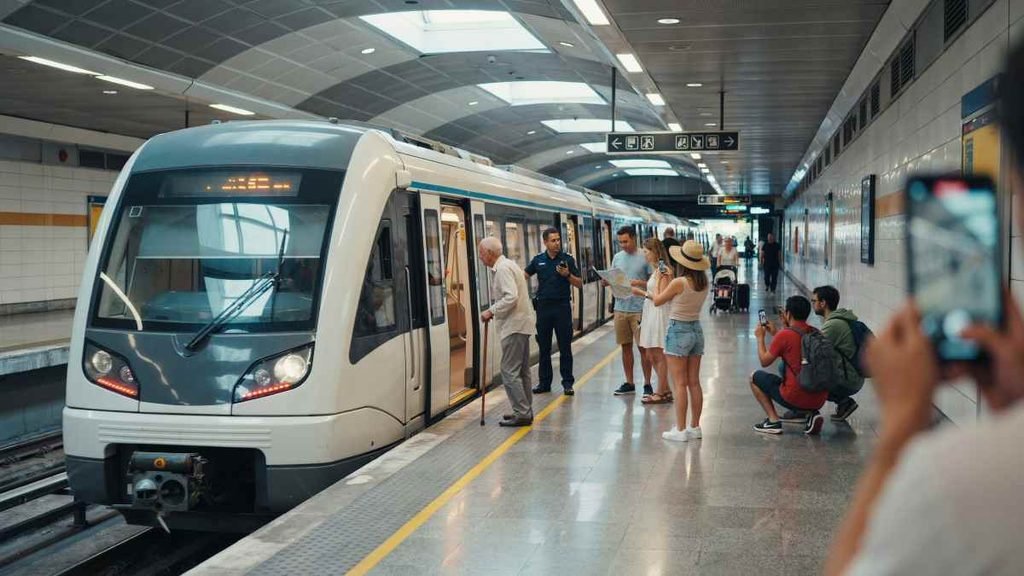
The core mission of these weekend closures is to test two newly rolled-out driverless trains. Technical teams will conduct high- and low-speed operational tests in the closed sections to verify the overall stability of signaling, communications, and platform management systems. The platform screen door facilities, which complement the automated system, have also entered the final calibration phase. Currently, the installation of platform screen doors at the 8 affected stations has been completed, with full finalization expected by late September. Once operational, the gap between the train and the platform will be kept under 3 centimeters, thereby significantly reducing the risk of passenger falls or trapping accidents.
Long-Term Plans for Capacity Expansion
Automation upgrades are a pivotal strategy for Madrid Metro to enhance its overall network capacity. Once Line 6 fully implements driverless operations, the line’s daily carrying capacity is projected to surge significantly from the current 400,000 to 730,000 passengers. Furthermore, train intervals are expected to be shortened to 2 minutes. Although weekend travelers will need to adapt to temporary partial closures and shuttle detours in the short term, this series of hardware and system upgrades will ultimately alleviate congestion across the urban rail network significantly during peak hours.
