In 2025, Spain’s national average monthly salary was recorded at €2,055, achieving a 3.4% increase from the previous year. However, because the cumulative inflation rate in recent years has outpaced wage growth, the actual purchasing power of Spain’s working class has declined. Meanwhile, significant structural disparities in salary levels persist among the various autonomous communities.
Wage Growth Lags Behind Inflation, Pressuring Actual Purchasing Power
Macroeconomic data indicates that the average monthly salary of the Spanish working class reached approximately €2,055 in 2025. This figure represents a 3.4% rise compared to the prior year, translating to an absolute monthly increase of €67, or roughly €804 annually. Furthermore, according to relevant policy planning, Spain’s interprofessional minimum wage (SMI) for 2026 will be set at €1,221 per month (calculated based on 14 payments per year).
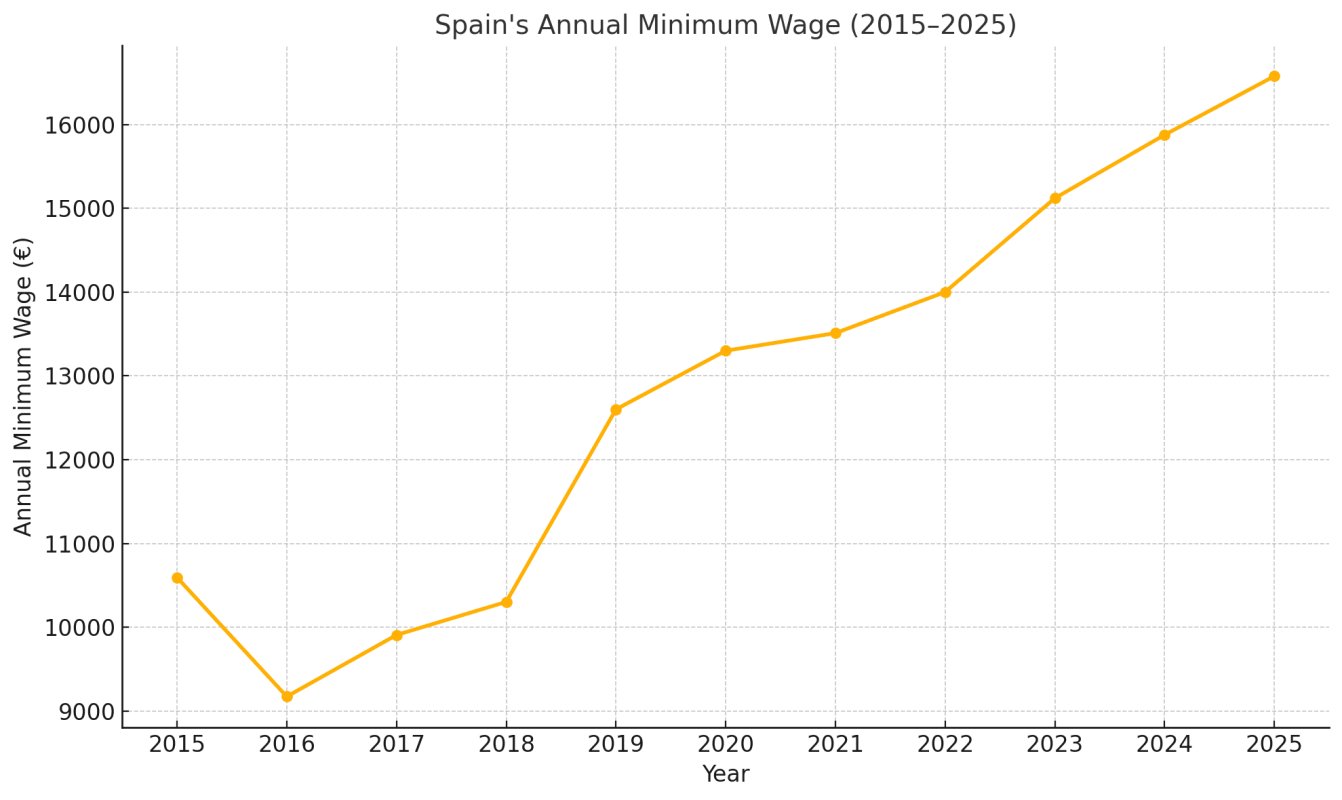
Although nominal wages have increased, the actual standard of living for citizens has not seen an equivalent improvement. Statistics show that from 2019 to 2025, the cumulative growth in national wages in Spain was approximately 21.3%, while the cumulative inflation rate during the same period exceeded 22.7%. This implies that wage increases have failed to fully offset rising prices, leaving ordinary families facing undiminished financial pressure from daily expenses such as housing, food, and energy.
Driven by Industrial Structure, High-Income Regions Concentrate in Core Economic Zones
On a national scale, salary levels across different autonomous communities exhibit clear polarization. The Community of Madrid leads the country with an average monthly salary of approximately €2,451. It is closely followed by the Basque Country (País Vasco), with an average monthly wage of around €2,328, while its provinces of Biscay (Bizkaia) and Gipuzkoa recorded €2,289 and €2,276, respectively.
The average monthly salary in the autonomous community of Catalonia is approximately €2,203, with its capital, Barcelona, maintaining the same level of €2,203. In contrast, other provinces within the community are slightly lower: Tarragona, Girona, and Lleida stand at €1,977, €1,876, and €1,780, respectively. High-wage regions typically host a higher density of multinational corporate headquarters and boast more robust industrial structures in finance, energy, automotive manufacturing, and advanced industries.
Significant Regional Disparities Leave Residents in Many Areas Facing Cost-of-Living Challenges
In stark contrast to the core economic zones, regions with relatively homogeneous industrial structures lag significantly in salary levels. The autonomous community of Extremadura has an average monthly salary of only about €1,603, with its provinces of Cáceres and Badajoz hovering around €1,600. In the overseas autonomous cities, the average monthly salaries in Ceuta and Melilla drop further to €1,488 and €1,542. Even within the Iberian Peninsula, provinces in the south such as Almería (€1,580) and Málaga (€1,923) exhibit a substantial gap of over €300.
Notably, affected by the across-the-board rise in prices, multiple autonomous communities—including Asturias, Cantabria, Murcia, Aragón, Galicia, and Navarre (Navarra)—have experienced a phenomenon where wage growth fails to cover the increased cost of living. For ordinary families in these regions, their actual disposable income at the end of the month is gradually shrinking.
