Official Advice: Maintain a Constant Low-Temperature Range
The Spanish Agency for Food Safety and Nutrition (AESAN) and relevant European media recently issued guidelines stating that refrigerator settings should primarily aim to inhibit bacterial growth and extend food shelf life. Officials recommend that, regardless of outdoor temperature changes, the household fridge compartment should remain between 0°C and 5°C, with 4°C being the ideal temperature. The freezer should be maintained at a standard -18°C.
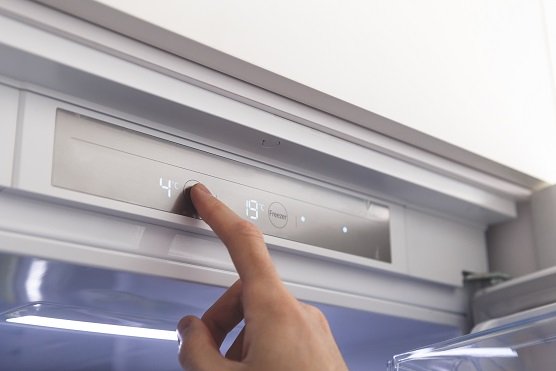
For devices with digital displays, users can set precise temperatures directly. Conversely, for traditional mechanical knob fridges, the numbers represent power output rather than actual degrees Celsius. Consumers are advised to check the product manual or use an independent thermometer for calibration. Officials also explicitly warn against setting the fridge temperature too close to 0°C to prevent irreversible freezing of ingredients near the cooling backplate or air vents.
Smart Organization: Prevent Cross-Contamination and Blocked Airflow
Beyond temperature control, proper physical layout inside the appliance is critical for food safety. Since the fridge door is frequently exposed to outside air, it experiences the most dramatic temperature fluctuations. This area is only suitable for items less prone to spoilage, such as condiments or beverages.
Raw meat, poultry, and fresh seafood easily harbor pathogenic bacteria. They must be tightly sealed and stored on the lowest shelf of the fridge to prevent juices from dripping and contaminating ready-to-eat foods. Fresh produce should be kept in dedicated humidity-controlled crisper drawers. Experts also emphasize avoiding overloading the fridge. Sufficient space must be left between items to allow unobstructed cold air circulation, ensuring a balanced temperature throughout.
Special Situations: Risks of Unconventional Placement
Experts have issued a specific warning for households keeping spare fridges in unheated spaces like garages or enclosed balconies. As outdoor temperatures plummet during autumn and winter, these appliances are exposed to extreme cold, which may lead to thermostat failures or compressor malfunctions.
In these specific situations, users must carefully review the manufacturer’s recommended ambient operating temperature range (climate class). Confirming the appliance’s minimal operational limits prevents potential equipment damage or massive food spoilage caused by unexpected shutdowns.
