87-Year-Old Evicted in Madrid: 71 Years of Residency Ends Amid Massive Protests Over Rent Hike
Corporate Takeover Triggers Fourfold Rent Increase
The roots of this housing dispute, which has captured nationwide attention in Spain, date back over half a century. Since 1956, Maricarmen and her family had lived in this apartment in Madrid’s Retiro district, legally inheriting the lease after her father’s passing. Her 71 years of peaceful life came to an abrupt halt in 2018 when the real estate asset management and development company Urbagestion Desarrollo e Inversion officially took over the property.
Based on a reinterpretation of lease clauses, the new owner demanded a massive rent hike from approximately 500 euros to 2,650 euros per month, an increase of over 400%. For an 87-year-old relying on a monthly pension of 1,300 to 1,350 euros, this was an astronomical figure. Even when the investors later lowered their asking price to 1,650 euros, it still exceeded her total financial capacity. This plunged both parties into a years-long legal tug-of-war, during which three failed eviction attempts occurred.
Fourth Eviction Attempt and Thwarted External Rescue
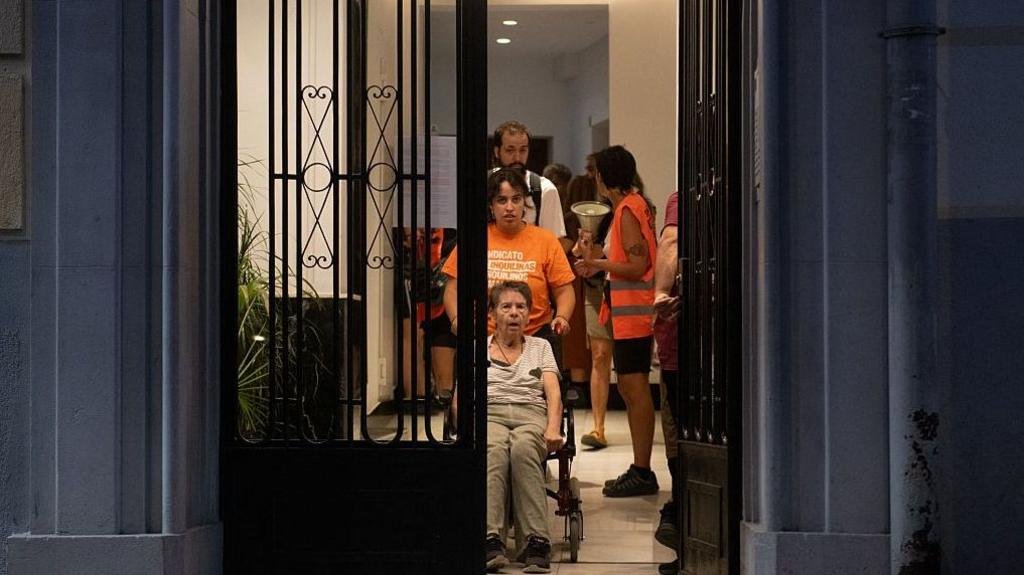
Early on the morning of September 23, 2026, Madrid police cordoned off the street to officially carry out the fourth eviction attempt. Hundreds of protesters gathered at the scene, answering the call of local tenant organizations. The crowd included many young people as well as Spanish public figures like actor Carlos Bardem and singer Ana Belen. Riot police clashed with protesters trying to block the building’s entrance, and several activists were forcibly removed from the area.
Ultimately, the wheelchair-bound Maricarmen was carried out of the apartment on a stretcher by medical staff and transferred by ambulance to Gregorio Maranon Hospital in Madrid. Earlier, there had been a chance to turn things around: according to her lawyer, Beatriz Duro, a well-known anonymous female writer had contacted the tenant organization, offering to pay the difference between the old and new rent out of pocket. However, the property company flatly rejected this financial compensation plan from an external party, and prior mediation efforts by the Spanish housing department also failed to reach a settlement.
International Intervention and Systemic Housing Crisis
The extreme nature of this case had already alarmed international institutions. In June 2026, the UN Committee on Economic, Social and Cultural Rights specifically intervened, urging a suspension of the eviction process and requesting affordable alternative housing for her. Amnesty International Spain also issued a statement afterward, severely criticizing the current system for failing to effectively guarantee the basic housing rights of vulnerable groups.
Maricarmen’s ordeal is essentially a microcosm of the deep-seated housing crisis in major Spanish cities. In hotspots like Madrid and Barcelona, chronic housing shortages, the unregulated expansion of short-term tourist rentals, and a slowdown in new residential construction have collectively driven up living costs. In Madrid, for instance, statistics from the real estate data platform Idealista show that the average rent has more than doubled over the past decade. This incident has further intensified the fierce political debate in Spain between two opposing approaches: “capping rents to protect tenants” versus “accelerating construction to expand supply.”
