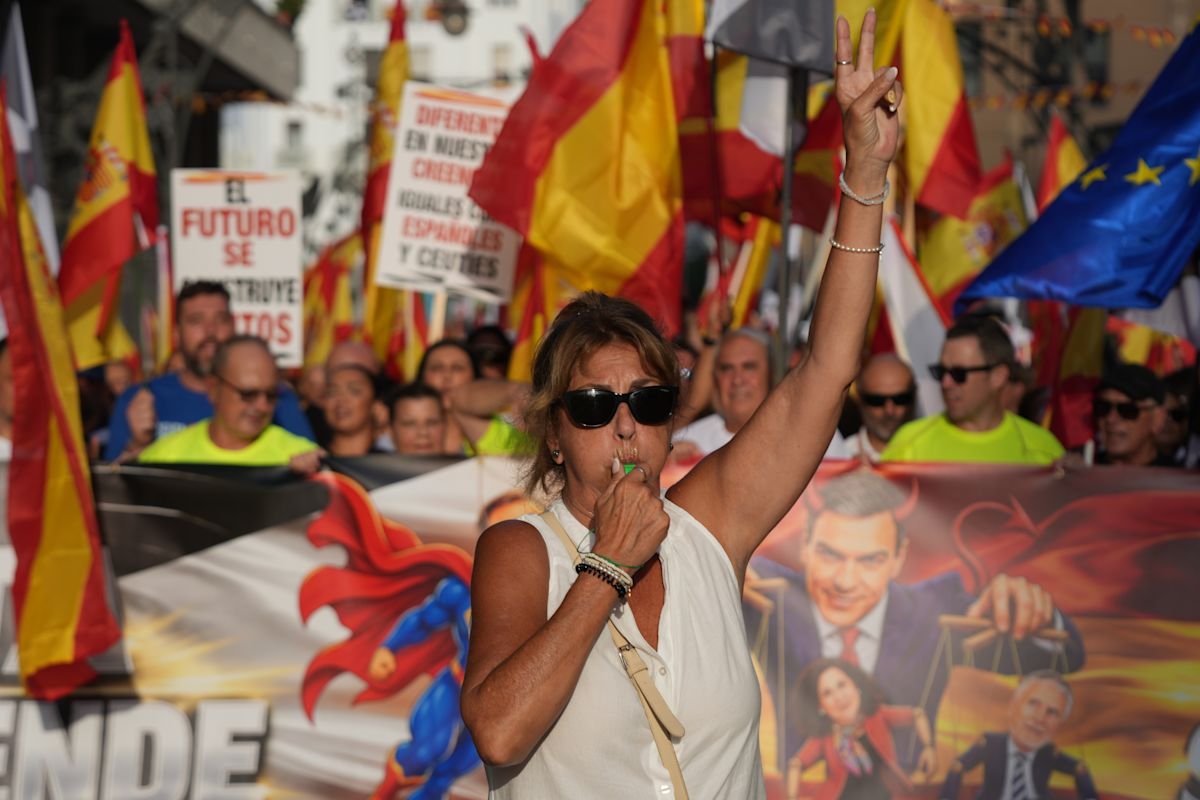
On September 26, massive demonstrations erupted in the Spanish capital, Madrid. Tens of thousands of people took to the streets under the organization of Sociedad Civil Espanola, strongly criticizing the incumbent government’s handling of the Ceuta immigration crisis and explicitly demanding the resignation of Prime Minister Pedro Sanchez and the calling of early national elections.
Protest Scale and Route Disputes
This protest, dubbed the ‘March for Dignity’, is the second large-scale demonstration launched by the organization. The procession gathered at the Plaza de Cibeles in central Madrid and eventually marched to the Moncloa area, where the prime minister’s office is located. Regarding the number of participants, statistical data from various authorities showed significant discrepancies: the Madrid government delegation initially estimated the turnout at around 20,000, while the organizers insisted that the number of protesters reached up to 180,000.
Ceuta Crisis Ignites Public Dissatisfaction
The core catalyst for this march was the recently escalating Ceuta immigration crisis. At the end of July this year, a large number of irregular immigrants surged into Ceuta, a Spanish enclave in North Africa, from the Moroccan border. This sudden influx pushed local social reception capacities, public services, and administrative systems to the brink of collapse, while also triggering severe political tremors within Spain. Demonstrators held banners opposing the current cabinet and chanted slogans demanding stronger border controls, accusing the central government of responding sluggishly and lacking effective resolution mechanisms after the crisis broke out.
Opposition Party Pressure and Tough Political Demands
Several heavyweight political figures from the right-wing camp attended the march, including Miguel Tellado, Secretary General of the Popular Party (PP), and Santiago Abascal, President of Vox. Although the two major opposition parties differ in their specific strategies for handling bilateral relations with Morocco, both directed their political focus against the current ruling coalition.
In addition to demanding the immediate dissolution of parliament and early elections, the protest organizers and some political parties put forward even more radical political propositions in a joint declaration. The declaration explicitly called for the initiation of relevant judicial procedures under Article 102 of the Spanish Constitution to investigate whether Prime Minister Sanchez is suspected of ‘treason’. Abascal publicly spoke out at the scene, urging the Popular Party to support and advance this investigation agenda at the national parliamentary level; Tellado focused his speech on criticizing the government’s border policies, reiterating the firm stance that a change of political leadership must be achieved as soon as possible.
