Local time on Friday afternoon, a passenger plane flying from Zurich, Switzerland to Valencia, Spain, encountered a technical failure during the landing phase, and the crew issued a highest-level “Mayday” distress signal. This emergency caused the airspace and runway of Valencia’s Manises Airport to be temporarily closed, forcing as many as six arriving flights to divert to the neighboring Alicante-Elche Airport. Ultimately, the involved aircraft made a safe emergency landing. After emergency cleaning of an oil leak on the runway, the airport resumed normal operations at 16:14 that day.
Aborted Approach and Emergency Distress Call
On the afternoon of the incident, a commercial passenger plane originating from Zurich, Switzerland entered Spanish airspace, preparing for a routine approach to Runway 12 at Valencia’s Manises Airport (Aeropuerto de Manises). While at a low altitude, the captain suddenly decided to abort the landing procedure, executed a go-around, and requested air traffic control for permission to circle above the airport to perform a technical self-check.
While holding in a holding pattern, the aircraft’s mechanical or technical indicators sharply deteriorated. Based on a comprehensive assessment of flight safety, the crew decisively declared a state of emergency to the tower and directly issued a “Mayday” signal, representing the highest level of emergency in the international aviation community.
ATC Emergency Response and Mass Flight Diversions
Upon receiving the “Mayday” command, the Valencia tower and related air traffic control departments swiftly activated the highest-level priority emergency plan. To ensure the absolute safety of the aircraft in distress during landing, the air traffic control department completely halted all takeoff and landing operations at Valencia Airport at that time, allocating all airspace and runway resources to the involved aircraft.
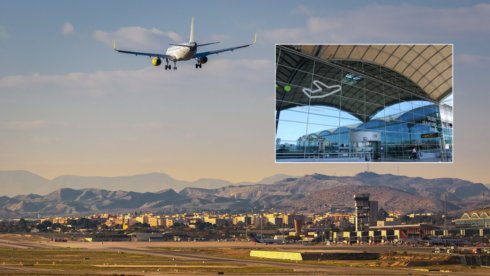
Due to the momentary lockdown of Manises Airport, multiple other passenger planes scheduled to arrive around the same time were unable to land. Following urgent coordination by the air traffic dispatch center, a total of six flights temporarily altered their routes mid-air, turning south to divert to Alicante-Elche Airport (Aeropuerto de Alicante-Elche). The concentrated influx of diverted flights posed a severe challenge to ground support and passenger flow management at Alicante Airport.
Firefighters on Standby and Emergency Landing Oil Leak
In terms of ground support, the full dedicated fire and rescue team of Manises Airport was mobilized. Several heavy fire engines were positioned on both sides of the runway, on high alert and ready to extinguish any fires or mitigate other extreme secondary disasters that might occur during the emergency landing.
Ultimately, the passenger plane touched down safely under the close monitoring of ground personnel. However, after coming to a complete stop, the aircraft entirely lost its autonomous taxiing capability and was forced to remain stranded in the middle of the runway. Subsequent on-site inspections revealed a massive oil leak from the lower part of the fuselage. A large amount of oil severely contaminated the runway surface, creating a safety hazard that could not be ignored.
Crisis Resolution and Resumption of Operations
Airport maintenance and engineering logistics personnel immediately intervened, initiating the towing of the involved aircraft and deep cleaning of the oil on the runway surface. During this period, the airport remained in a state of suspension.
According to an official briefing from the Valencia Airport tower, it was not until 16:14 that afternoon that the oil stains and related obstacles on the incident runway were completely cleared, and the runway once again met safety standards such as the airworthiness friction coefficient. Subsequently, Valencia’s Manises Airport officially announced its reopening, and arriving and departing flights gradually resumed normalized operations. This mid-air emergency, which affected aviation hubs in two provinces, was finally smoothly resolved.
