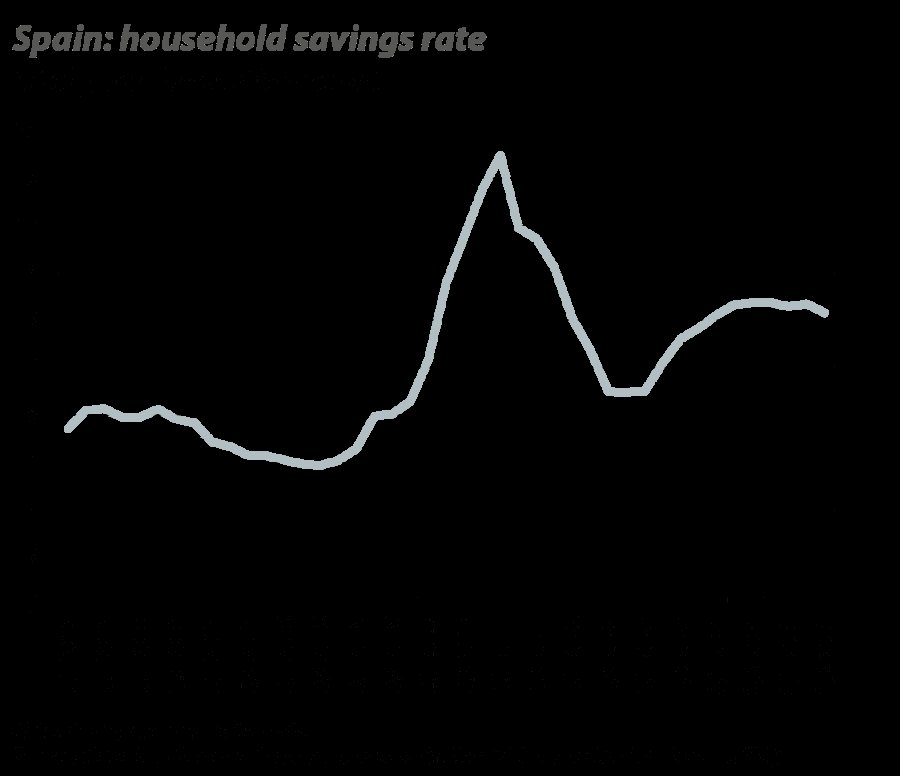
According to the latest data released by the Spanish National Statistics Institute (INE), the financial situation of Spanish households in the second quarter of 2026 showed a prominent trend of “high consumption, low savings.” The household savings rate for the quarter slipped to 11% of disposable income, setting the lowest record since the first quarter of 2023.
Consumption Growth Comprehensively Outpaces Income Growth
Statistical data indicates that although the overall income level of Spanish households remains on an upward trajectory, robust consumption expenditure has easily wiped out the financial surplus generated by income. In the second quarter of 2026, the gross disposable income of Spanish households reached 303.93 billion euros, an increase of 5.5% compared to the same period in 2025. However, household final consumption expenditure during the same period was as high as 247.41 billion euros, marking a staggering year-on-year increase of 7.1%.
Since the growth rate of expenditure was significantly faster than that of income, it directly caused the total household savings in the second quarter to shrink by 0.6% year-on-year, recording only 57.02 billion euros. Compared to the second quarter of 2025, the current savings rate of 11% has dropped by 1 percentage point; even compared to the first quarter of 2026, it fell by 0.6 percentage points. Aside from daily consumption, Spanish households also showed active investment expenditure, reaching 21.91 billion euros, a year-on-year increase of 5.6%.
Macroeconomy Faces Contracting Financing Capacity
At the macroeconomic level, although Spain’s gross national income and gross national disposable income both achieved a 5.3% year-on-year growth in the second quarter, the structural changes in overall capital flows still warrant caution.
Data shows that the financing capacity of the entire Spanish national economy to the rest of the world has significantly dropped to 13.65 billion euros, equivalent to only 3.1% of the country’s Gross Domestic Product (GDP). Compared to the same period last year, this amount plummeted by approximately 5.8 billion euros. Furthermore, the financing needs of public administrations are continuously expanding, while the capital retention of other economic entities, such as non-financial corporations, has also experienced varying degrees of consolidation.
Household Financial Buffer Under Pressure
Macroeconomic data reveals a straightforward practical challenge: although the total income of Spanish citizens is increasing, high price costs are gradually offsetting these dividends. Rigid expenses such as housing, food, and daily services are disproportionately devouring the overall budget of families.
Looking at the 11% savings rate indicator, it implies that for every 100 euros of disposable income an average household earns, approximately 89 euros must be spent on living consumption and various expenses. In an environment of persistently high expenditure, the portion of funds that can truly be converted into bank deposits is continuously shrinking. Due to reduced savings accumulation, the financial buffer of ordinary households in the country has been significantly weakened when facing potential future economic fluctuations.
