Sudden Shift in Market Trends: Significant Decline in July Mortgage Issuance
The Spanish mortgage market has recently shown significant cooling signals. According to the latest data released by the Spanish National Statistics Institute (INE), the Spanish banking sector issued a total of 43,372 home mortgages in July this year, representing a 3.5% decrease compared to the same period last year. This figure marks the largest year-on-year decline since June 2024. Compared to the impressive 10.8% year-on-year growth rate in June, the market performance in July took a sharp downturn.
Looking at the macroeconomic data for the first seven months of the year, the Spanish real estate market completed 408,881 housing transactions, a year-on-year decrease of 3%; meanwhile, a cumulative total of 303,056 home mortgages were issued during the same period, maintaining a 5.4% year-on-year growth. However, the pullback in July’s single-month data has sparked market concerns regarding the vibrancy of the property market in the second half of the year.
Rising Financing Costs: Average Interest Rate Returns to the 3% Mark
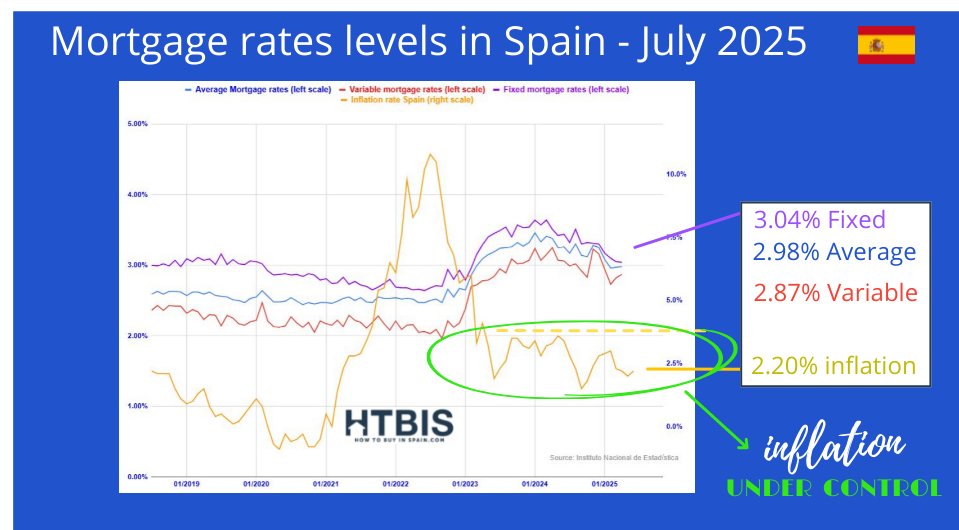
While loan volumes are decreasing, financing costs for homebuyers are climbing. Data indicates that the average interest rate for new home mortgages in July reached 3.01%. This marks the first time since January 2025 that this indicator has once again breached the crucial psychological threshold of 3%.
Furthermore, the average loan amount for homebuyers continues to rise, reaching 180,785 euros in July. This represents a substantial year-on-year growth of 10.9% and sets a new historical record. Regarding the distribution of loan types, fixed-rate mortgages remain the top choice for Spanish homebuyers, accounting for 62.3% of the total with an average interest rate of 3.03%. Meanwhile, variable-rate mortgages make up 37.7%, offering a slightly lower starting average interest rate of 2.97%.
Clear Regional Divergence: Four Autonomous Communities Account for 80% of National Mortgages
The mortgage market across different regions of Spain is exhibiting strong regional divergence. In July, mortgage issuance in some areas maintained bucking-the-trend growth, with the Balearic Islands (Islas Baleares) leading the country with an 8.6% year-on-year increase. Asturias and Galicia recorded growths of 8.1% and 7.1%, respectively.
In contrast, Cantabria, Aragon, and La Rioja suffered the most severe declines, plummeting by 26.9%, 20.5%, and 19.7%, respectively.
In terms of absolute numbers, Catalonia (Cataluña), Andalusia (Andalucía), the Community of Madrid (Comunidad de Madrid), and the Valencian Community (Comunitat Valenciana) remain the core hubs of the Spanish real estate market. These four autonomous communities signed 11,169, 10,642, 7,480, and 6,960 loans in July, respectively, collectively accounting for over 80% of the total home mortgages issued nationwide that month.
Industry Outlook: Fixed Rates May Face Upward Pressure by Year-End
Addressing the current volatility in the real estate financing market, industry experts warn homebuyers to be vigilant of potentially increasing financial burdens in the future. Ricard Garriga, head of the mortgage platform Trioteca, pointed out that while competitive fixed-rate products can still be found on the market today, this “window of opportunity” is gradually narrowing. As the market environment evolves, it is expected that quotes for certain fixed-rate mortgage products will become more expensive by the end of this year.
Overall, under the dual squeeze of high housing prices and high financing costs, the financial pressure on Spanish homebuyers is becoming apparent. The specific direction of future Spanish mortgage rates will continue to rely heavily on the monetary policy adjustments of the European Central Bank (ECB), the evolution of inflation data, and the specific credit thresholds of major commercial banks.
