Major Update to Spanish Traffic Regulations: New Rules Fully Implemented on October 1
In accordance with Royal Decree 518/2026 issued by the General Directorate of Traffic (Dirección General de Tráfico, DGT), the new General Regulations for Traffic and Road Safety will officially take effect on October 1, 2026. This extensive revision of the law affects all road users, from motor vehicle drivers to e-scooter riders, aiming to enhance overall road safety.
Motorcycles and E-scooters: New Rules for Gear and Right-of-Way
For two-wheeled vehicles, the new regulations specify stricter requirements for safety equipment and traffic access:
Motorcyclists:
- Mandatory Gear: Regardless of weather or distance, riders of motorcycles or mopeds must wear footwear that fully covers the feet. Wearing flip-flops or sandals is strictly prohibited and considered a serious offense, punishable by a €200 fine. On interurban roads, both the driver and passenger must also wear protective gloves.
- Navigating Congestion: During severe traffic jams where vehicles are stationary, motorcycles are permitted to use the right shoulder (arcén derecho) to proceed, but their speed must not exceed 30 km/h.
- Professional Riders: Motorcycle riders working in delivery services (e.g., couriers, food delivery) must wear a reflective vest while on duty.
E-scooter (VMP) Users:
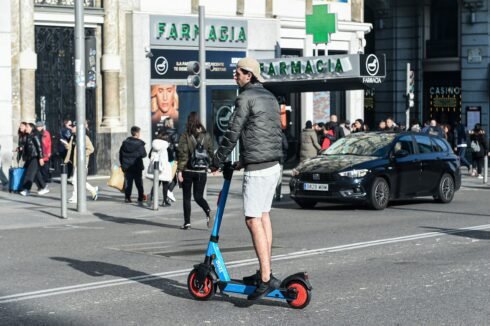
- Age and Equipment: The minimum legal age for riders is set at 15 years old. All users are required to wear a safety helmet and keep the vehicle’s lights on at all times while riding. At night or in low visibility conditions, they must also wear reflective gear.
- Right-of-Way Restrictions: E-scooters are strictly forbidden from riding on sidewalks. They are also not allowed to travel against traffic on one-way streets unless explicitly permitted by signage.
New Rules for Motor Vehicles: Enhancing Protection for Vulnerable Users and Emergency Response
The new regulations place higher demands on motor vehicle drivers, especially when interacting with other road users:
- Overtaking Cyclists: When overtaking a cyclist, drivers must not only maintain the legally required lateral safety distance but also reduce their speed to at least 20 km/h below the road’s maximum speed limit. When following a cyclist in the same lane on urban roads, a minimum safety distance of 5 meters must be maintained.
- Passing Stationary Vehicles: When passing a vehicle stopped on the roadside due to an accident or breakdown, as well as road maintenance vehicles, drivers must maintain a lateral distance of at least 1.5 meters and reduce their speed to at least 20 km/h below the road’s speed limit.
- Creating an “Emergency Corridor”: In the event of severe congestion on highways or major roads, all vehicles must actively move to the sides of their respective lanes to create a central corridor for emergency vehicles (such as ambulances and police cars) to pass.
General Rule Adjustments: Elimination of Several Exemptions
Some long-standing rule details and exemptions have been updated or removed:
- Elimination of Seatbelt Exemptions: The previous rule allowing taxi drivers in urban areas, freight drivers during short-distance loading/unloading, and driving instructors during lessons to be exempt from wearing a seatbelt has been completely abolished. All drivers and passengers must wear a seatbelt, with the only exception being medical personnel providing emergency care inside an ambulance.
- Traffic Light Adjustments: To eliminate the risk of conflict between vehicles and pedestrians, the design of intersections with a “flashing amber light” that allows vehicles to turn right while the pedestrian signal is green will be phased out in principle.
- Cycling Regulations: The requirement to wear a helmet when cycling on interurban roads will no longer have any exceptions. Additionally, like e-scooters, bicycles are strictly prohibited from being ridden on sidewalks.
