For brothers and sisters just arriving in Spain, do you often find yourself confused every time you visit the ham section of the supermarket? Black, red, green, white—all with quite varied prices. Today, I want to share my personal take on what I think is a high value-for-money choice—the Red Label ham. When I first arrived, I hesitated a lot, not knowing if it really tasted good or if it was worth the price. Now that I’ve figured it out, I’d like to share some insights with you!
First, we need to clarify—what exactly is this “Red Label”? In Spain, the color label on ham represents its grade. The full name of Red Label is Jamón de Cebo de Campo Ibérico, which means “field-farmed Iberian ham.” The key information about Spanish Red Label Long Ham is: the pigs are Iberian black pigs raised in fields where they roam freely and feed on a mix of pasture, natural crops, and grain feed. Therefore, it inherits the excellent genes of black pigs and gets some exercise, but unlike the top-tier Black Label, it doesn’t feed exclusively on acorns.
Quick Guide to the Four Ham Label Colors
To make it easier to understand visually, I made a simple table to show where the Red Label fits in the entire family:
| Label Color | Spanish Name | Pig Breed | Farming Method and Diet |
|---|
| Black | Bellota 100% Ibérico | 100% purebred Iberian black pig | Free-range forest grazing, pure acorn-fed |
| Red | Bellota Ibérico / Cebo de Campo Ibérico | 50%/75% Iberian black pig | The former is forest free-range acorn-fed, the latter is field-farmed with natural crops and feed |
| Green | Cebo de Campo Ibérico | 50%/75% Iberian black pig | Field-farmed, natural crops and feed |
| White | Cebo Ibérico | 50%/75% Iberian black pig | Confined farming, pure feed-fed |
Note: According to new regulations, Red Label specifically refers to Bellota Ibérico, and Green Label to Cebo de Campo. However, many products in the market still follow the old standards, where Red Label represents Cebo de Campo. When buying, rely on the text on the label. Here, the Spanish Red Label Ham Sauce I discuss refers to the commonly called Cebo de Campo level.
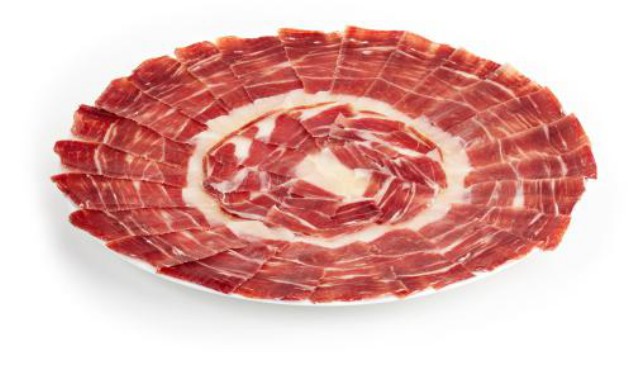
So how does it taste? I think Red Label ham strikes a perfect balance. Its marbling is very beautiful, much richer than White Label and Serrano hams, clearly delivering that rich and mellow flavor with layered aroma. Yet, it’s not as intense as the premium Black Label, whose acorn flavor is extremely rich and expensive. Red Label has a smooth texture, moderate saltiness, chewy but not dry meat, and a subtle nutty aftertaste that’s very enchanting. For those starting to explore Iberian ham, this flavor profile is highly acceptable.
If you want to experience the true charm of Iberian ham but find the Black Label a bit extravagant, the Red Label is definitely your best choice. It tastes much better than regular Serrano ham and clearly lets you appreciate the unique flavor of Iberian black pigs. You can find sliced portions in ham counters at big supermarkets like Mercadona and Carrefour, or go to a specialty ham shop to buy a whole leg or have it thinly sliced by an expert. Paired with a slice of bread or a glass of red wine, it’s pure enjoyment.Of course, eating it plain is the best! Which brand of Red Label ham do you prefer? Feel free to share your thoughts in the comments below!
