For newcomers to Spain, does seeing rows of shiny ham legs at the supermarket or ham shop make your head spin? Especially when you hear words like “Pata Negra” or “Bellota,” do you feel a bit lost? Don’t worry, today we’ll talk about the pinnacle of Spanish ham—the Black Label Ham. After reading this, you’ll confidently shop for ham like a seasoned expat!
What Exactly Is “Black Label Ham”?
First, let’s clear up a common misconception: not all ham from black-hoofed pigs is Black Label Ham! The true Black Label Ham is officially called Jamón 100% Ibérico de Bellota. This name contains three key pieces of information:
- 100% Ibérico: The pig’s bloodline must be 100% pure Iberian black-hoofed. If crossbred with other breeds like Duroc, it cannot be called 100% Ibérico.
- de Bellota: This is the most important part, meaning that in the last few months of its life, the pig was free-range in oak forests, feeding mainly on fallen acorns. The acorns bring the unique nutty aroma and melt-in-your-mouth fat found in Spanish Black Label Ham slices.
- Black Label: This is the official certification. Every ham leg that meets these standards has a black plastic tag with a unique serial number. This is the “ID card” of Spanish 5J Black Label Ham.
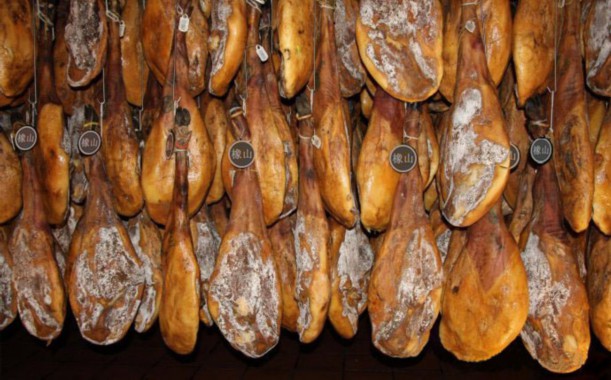
Four-Color Tag System: Understand Ham Grades at a Glance
To help consumers distinguish quality, the Spanish government introduced a four-color tag system. Besides the Black Label Spanish 5J ham we’ve discussed, there are three other types with descending quality and price. I made a simple table for you to save and check next time you buy, so you won’t go wrong:
| Tag Color | Spanish Name | Pig Breed | Feeding Method |
|---|
| Black | 100% Ibérico de Bellota | 100% Iberian pig | Acorn-fed, free-range |
| Red | Ibérico de Bellota | 50% or 75% Iberian pig | Acorn-fed, free-range |
| Green | Ibérico de Cebo de Campo | Over 50% Iberian pig | Grain + pasture, semi free-range |
| White | Ibérico de Cebo | Over 50% Iberian pig | Grain-fed, confined |
So next time you buy sliced ham, remember to check the colored tag on the back of the packaging. That will instantly tell you its grade. You get what you pay for —the Black Label is the most expensive but its unique flavor is definitely worth trying.
Tips for Buying and Tasting
For ordinary people, buying a whole ham leg is unrealistic. Pre-sliced, boxed ham at supermarkets is the most convenient choice. Try to select hand-sliced ham; it’s a bit pricier but tastes far better than machine-sliced. Before eating, take the ham out of the fridge about half an hour in advance to let it reach room temperature. This slightly melts the fat and fully releases the aroma. No accompaniments are necessary; eat it directly or with just a simple piece of bread for a divine experience. The salty richness melting in your mouth is truly addictive!
After all this info, the best way is still to taste it yourself. Where do you usually buy your ham? Do you have favorite brands or producing areas? Feel free to leave comments below and share recommendations!
