If you’re new to Spain, do you find yourself dazzled by row after row of magnificent hams every time you enter a supermarket or a Tapas bar? I felt the same when I first arrived—everything looks so similar, yet prices differ dramatically. Today, let’s talk about the Spanish national treasure known as Iberian ham and share some personal tips to help you avoid mistakes and enjoy it to the fullest!
Don’t be fooled by flashy packaging; the key to understanding Iberian ham is learning to read the small plastic tag hanging from the leg. This is the official “ID card,” where different colors represent completely different grades and qualities. Remembering this will basically save you from getting scammed.
The Ham “ID Card”: Four Color Tags
To make it easy for everyone, I’ve organized a simple chart about Spanish cured hams for a clear overview:
| Tag Color | Grade Name | Pig Breed Purity & Feeding Method |
|---|
| Black | Bellota 100% Ibérico | 100% purebred Iberian black pig, free-range in oak forests, acorn-fed |
| Red | Bellota Ibérico | 50% or 75% Iberian lineage, free-range in oak forests, acorn-fed |
| Green | Cebo de Campo Ibérico | Over 50% Iberian lineage, pasture-raised, fed on fodder and natural foods |
| White | Cebo Ibérico | Over 50% Iberian lineage, penned, fed only on fodder |
What Exactly Is the Difference Between Bellota and Cebo?
Simply put, Bellota means acorn-fed. This is the essence of the flavor of Iberian ham matured at Spanish ham curing altitudes. The pigs roam freely in oak forests, eating natural acorns; the fat infiltrates the muscles, creating beautiful marbling patterns. The taste is sweet and fragrant, rich but not greasy, with a long-lasting aftertaste. On the other hand, Cebo means fodder-fed, resulting in a relatively straightforward and simple flavor profile, and the price is much more affordable. For daily consumption, the green-labeled Cebo de Campo offers excellent value, but if you want to try the true premium taste of Spanish cured ham, you must go for the black or red Bellota tags!
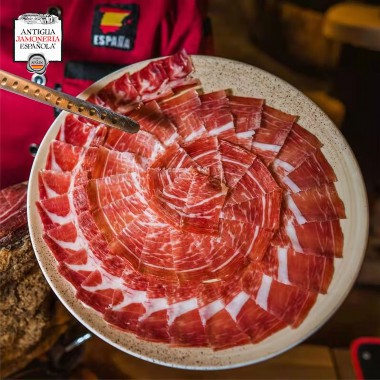
Finally, let’s talk about how to eat it. The most classic and pure way is to add nothing at all, eat it directly! Let the ham’s fat slowly melt on your tongue. Of course, pairing it with a slice of slightly crispy Pan con Tomate, or a glass of Tempranillo red wine, is simply divine. Oh, and many people now know ham goes well with melon, but actually, in Spain locals don’t eat it that way much anymore; it feels a bit outdated now, haha. I highly recommend trying hand-cut slices. Although a bit pricier, the craftsmanship of the master slicer preserves the full flavor of the ham in a way that machine-cut ham simply cannot match!
