If you’ve just arrived in Spain, you might wonder the same as I did. Every time I go to the supermarket, market, or just pass by a tavern, I see rows of shiny pork hind legs hanging there, really tempting to eat. But here’s the question: Spain’s climate, especially in the south, can be humid and hot in summer, so how do these hams hang for so long, even years, without molding or spoiling?
Later, after chatting with local food lovers and researching myself, I discovered the secret. The key lies in the salting and drying steps. This isn’t just sprinkling some salt and done. The first step in making Jamón is to bury the entire leg in abundant sea salt, using salt’s strong osmotic pressure to “push out” most of the moisture from the pork leg. Without moisture, most molds and bacteria lose their breeding ground. This principle is very similar to how cured meats like bacon or salted fish are made.
Dehydration is just step one; the true soul of Spanish ham is the subsequent Spanish ham mold lengthy curing process. The ham is hung in special curing cellars where Spanish ham mold causes temperature and humidity are precisely controlled to allow natural drying and fermentation for several months or even years. During this time, proteins and fats inside the ham slowly break down and transform, producing extremely complex flavor compounds. A hard shell forms on the surface, acting as a natural protective layer that further prevents external bacterial invasion.
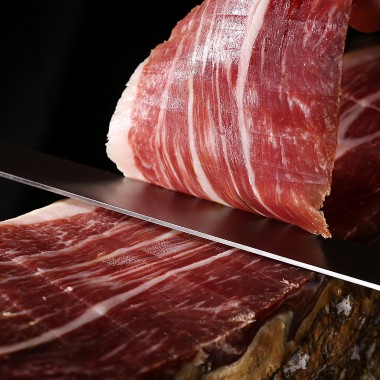
At this point, some friends might ask: ‘Wait, I clearly saw something like mold on some hams!’ Correct! But that mold is not harmful. During curing, the surface of the ham sometimes grows some mold, usually harmless or even beneficial penicillium molds, similar to those on cheese, which help develop unique flavors. These beneficial microbes form a “biological protective layer” that inhibits harmful bacteria’s growth. Before sale, these surface molds are cleaned off. So, the Spanish ham overall mold you see on finished hams are clean on the surface.
Another common misconception involves the small white spots on sliced ham that are not fat. Many people think they are salt grains or worse, parasite eggs. Actually, those are tyrosine crystals, amino acids produced during protein breakdown in the curing process—actually indicators of high quality and sufficiently long curing! Completely harmless and safe to eat. To help everyone understand better, I created a simple table:
| Phenomenon | What is it? | Can you eat it? |
|---|
| White/green mold on ham surface | Beneficial penicillium mold | Edible after cleaning; normal phenomenon |
| White spots inside slices | Tyrosine crystals | Edible; sign of high quality |
| Greasy feeling on ham surface | Natural fat seepage | Source of flavor and moisture |
| Black/red/harmful mold | Improper storage or spoilage | Do NOT eat! |
A qualified Spanish ham is truly a masterpiece of time and microbes, and the reason it doesn’t mold is thanks to a sophisticated and traditional craft. Next time you see hanging Jamón, don’t worry it’s ‘expired’ anymore. What other interesting Jamón facts do you know? Or any tips for storing opened ham? Feel free to discuss below!
